
Ask HN: What are you working on? (November 2026)
I’m still looking for work in the mean time but I’m proud of what I’ve achieved so far.
I have something vibed together as an internal tool that does well enough, but definitely not something I would ever refer to as a CRM by any stretch of the imagination and the bridge between basic on-the-shelf inventory and tracking rental assets are two completely different beasts. Maybe more of a prettier version of the spreadsheets we already use with more automated functionality would be more apt.
My real advice… start working for him and using the software yourself 100%. Even for $5 an hour so you both have skin in the game. Him to have some help, you to learn, but the money adds a bit of reality so neither of you do things only because it’s free or because it’s family.
My saas has improved leaps and bounds this year when I started to work in the industry for a company actually using my product. I learned things I never saw by just giving demos.
Out of curiosity, where did you get the name Crewbird?
Nice story but also kindof sad you didn't have time for this while you were working. Good example of what can happen if we don't work so much.
Maybe his father didn't want to worry his family, and had been keeping it to himself. I have no idea, and neither do you; you just chose to assume the worst about someone you don't know.
This feels like a very risky move.
My LGS recently got me in to have a look at building some custom systems for them. I looked at what they needed and was like:
> Hold up. You can pay me thousands of dollars to build something custom, and it will inevitably have on-going maintenance costs and high associated monthly costs for hosting + third-party API access (not amortized across multiple stores/clients), OR I could set you up on Shopify and a bunch of well maintained plug-ins.
So I'm cutting operating costs to the bare minimum. Today I shut down one service and replaced a VPS with Cloudflare Workers. I'm also trimming my SaaS subscriptions and self-hosting what I can.
Working on this website feels so pointless if it will end up dead in a year. I just returned from a vacation and realised that I just don't like being online anymore. I'll cut my expenses to a minimum, log off, and ride a motorcycle around the world. What happens after that is anyone's guess.
University of California San Diego has deployed our Wayfinder and Waystation web apps for their 35,000+ students!
We're getting ready to launch our Vehicle Positions software, which replaces expensive, proprietary vehicle location systems with free, open source software that runs on commodity smartphones.
Our next-generation server software, Maglev, is adding support for newer transit data formats, like GTFS-Flex so that we can show demand responsive transit systems on the map.
We are always looking for more developers, biz dev, ux designers, product managers, and more to help out!
Open volunteer positions: https://ossvolunteers.com/organizations/open-transit-softwar...
Our software: https://github.com/OneBusAway/
More about us: https://opentransitsoftwarefoundation.org
Shall be volunteering, thanks for sharing and keep up the great work!
you'll find a link to join our slack at the bottom of it.
Yes, it's another screenshot and recording tool. But this one has exactly the features I need, nothing more and nothing less. It's like a home-cooked meal. Sure, it's vibe-coded, but it has a bit of an engineer's touch.
Next generation of the devices won’t be ours at all, there will be no easy hacks. Turn off automatic updated, do backups, pray for chaos.
Drawdown (from 52-week high) charts for top performing YTD stocks of the NASDAQ 100:
https://chartrow.com/top-performers#view=drawdown&p=ytd&in=n...
View the stock charts of holdings of an ETF like ARKK in a dense way:
https://chartrow.com/quote/arkk/holdings#range=10y&ma=20%2C5...
Microsoft business fundamental trends:
https://chartrow.com/quote/msft/trends
Visualizing the top performing stocks in different ways:
https://chartrow.com/top-performers#view=charts&p=ytd
https://chartrow.com/top-performers#view=heatmap&p=ytd
https://chartrow.com/top-performers#view=calendar&p=ytd
Feel free to change views from charts to table to heatmap etc. And it should feel responsive. Report any bugs to me and happy viewing. :)
Thanks for the work, I’ll definitely dig into the code and I am curious to know how you made it so snappy !
Recently, this has been porting the wikipedia "Getting to philosophy"[0] to other gaming wikis, and working alongside agents got me to a really nice visualization[1] for it.
I'm now slowly working towards converting this to an immersive article so I can share some of the emerging patterns and evaluating the differences within the various wikis.
[0] https://en.wikipedia.org/wiki/Wikipedia:Getting_to_Philosoph...
[1] https://antonygarand.github.io/gaming-wiki-analysis/mesh/?
We built https://draw.redcrayon.ai, inspired by tools we love like Excalidraw: a live architecture board you and your coding agent draw on together. The agent connects over MCP (Claude Code, Cursor, Codex, claude.ai) and draws what it changes as it works. The edges are meant to cite a source line (or fingerprint). You read the board instead of walls of text, and you can circle something in red crayon to get the agent to answer/fix it.
What we use it for:
- An incident scratch pad, where the agent lays out what it finds while debugging
- Seeing how a change affects the architecture before reading the diff
- Flagging the risky parts, like a DB migration, with every piece of code that reads that table
- Github App that generates a diagram per PR (something that is a work in progress)
- Ever wanted to create a branch of your existing diagram rather than completely clone/copy it? That's something we added to draw.
Docs: https://docs.redcrayon.ai
OSS (Apache-2.0): https://github.com/redcrayonai/draw
The original idea was to try and correlate phase jitter to space weather, essentially using the mains power system as a sort of radio telescope. I never did get it working (although I did not have much time to try, either). I was able to see interesting things like generators spinning up to maintain the frequency though.
Will open source the hardware when done. I am not an astronomer, just some random fellow that investigates things at depth for no particular reason.
High precision instrumentation just uses a stable comparator to sync the AC line Zero crossing events, and times the sharp roll-off gap over several cycles to estimate the center transition event. This allows readings to be synced in the low-noise state of the power lines cycles, and time what the readings should be when monitoring the voltage, temperature, and current across the cycles.
Additionally, most >8-digit meters internal power supply will have a tuned filter for the 60Hz/50Hz line. Getting a line filter will often give a digit of precision on older equipment, and clip-on line chokes in bulk also help.
https://www.digikey.com/en/products/detail/eaton-tripp-lite/...
One final tip, anything beyond 12bits precision or 60MHz wide RF bandwidth for SDR will almost certainly have an export restriction. Wideband devices also have RF front end saturation issues, and usually require narrow band-pass filters to see the hydrogen line etc. Best of luck =3
It's primary purpose is for live boxscores because all of the major sports sites have terrible UI/UX experiences. I always defaulted to ESPN.com but it's so slow and awful. Center Court is basically a bridge between espn.com (or nba.com) and more advanced stat focused sites that don't offer a good live experience.
The technical implementation behind it is quite novel in this space too. Instead of storing computed statistics in a database, I store raw play by play payloads immutability and everything else is derived from those and can be trivially rebuilt so the event log is a derived cache of the payloads. Every stat on every page is a pure fold over the event log at request time; no derived number is stored.
This enables some powerful features like being able to re-derive a game's entire state at any point of the game (or even a time range). Example game to try out: https://centercourtlive.com/game/0022600197
The site is meant to be extremely fast. It's all server-side rendered with progressive JS enhancements. URLs are immutable and cached behind a CDN.
https://extremepuzzlebooks.com
A sample wordsearch is available as a pdf here: https://extremepuzzlebooks.com/assets/sample/extreme-wordsea...
I'm quite proud of this wordsearch concept as I've not seen it done before.
All the logic puzzles have an online solution to show step by step how you can complete them.
https://extremepuzzlebooks.com/walkthroughs
I've been working on the software to generate, test and verify these for a couple of years and finally built up enough puzzle stock that meets the difficulty requirements to properly launch.
Now the work is on every hackers favourite part... Marketing!
Somewhat related, I built a browser-based version of my favourite deduction game: https://github.com/kristiandupont/sherlock
*currently building a benchmark suite, reaching approx. 40% less ram usage, 40% faster input lag, less cpu usage in some activities, and faster responsiveness during high cpu usage (from other tasks)
Now we don't deploy this to private companies except some gov projects. But we are engaging existing IaaS and dedicated servers providers. Later hope we would fight with Broadcom and IBM :)
We previously ran a services company that built over 100 private clouds, then decided to turn that experience into a product with an aggressive level of automation to let DevOps, SRE, and platform teams hit a 1:300 ratio per developer (now dev + AI agent teams).
We are currently deployed across 12 datacenters and raising our seed round this month.
Regarding been curious, today I have created my first explainable video with Remotion +claude so if you want to see open edit results check https://promo-review-shalb-promo.stage.kube-dc.com/
Would be glad if you comment. Thanks!
Looking forward to see how your product develops. Would love to work with you in future.
From my hands-on engineering POV I often set this maybe not as a hard requirement but definitely a goal, and the places where it's not possible I find a little painful.
In your case where is it becoming something that doesn't make sense for you?
So I built Isomorphic, an open-source MCP that sits between the user and a markdown knowledge base in GitHub. It's kind of like Obsidian but it's "inside" Claude web, ChatGPT web, etc. Not a separate UX. Organizations keep their knowledge separate from the AI and interoperable, helps org build brains for customers, projects, internal teams. Conformant to Google's Open Knowledge Format.
Been having fun with it. Lots of learnings re: permissioning, version control, search. Working on dreaming and security features that catch when info goes stale, users upload sensitive info, etc.
A singing training app for bad singers. You sing the pitch line and get a score. Let's you sing to any original song by listening along and not playing the song itself.
Recently got some good feedback on HN https://news.ycombinator.com/item?id=50195488 and am following up with Linux and Windows versions and using Fable 5.1 to internationalise the app and landing page which explains the app.
I also still enjoy Opus 4.8 a lot more for creative discussions and design, even if benchmarks say he's not as smart. Opus 5/5.5 is so rigid!
https://cybersolar.earth - artist website for my solarpunk hiphop & drum n bass album coming out, plus some thoughts on climate+culture
https://newsdash.concourse.codes - basically: Perplexity for climate news. hardcoded to be personally relevant rn, uses Gemini to do some basic web search grounding. Turned out to be fairly helpful
https://arena.concourse.codes - Use are.na channels to 'fine tune' a Gemini image gen model and prompt what you want. Inspired by wishing I could easily tell Midjourney to quickly use a collection of 10 images to set the style of an image. gens limited as is WIP but fun to play with for a min (edit: ofc i share today & have UI bug! click the page header to fix for now, will fix later:D)
https://colors.concourse.codes - kinda janky atm but an attempt at crowdsourcing a color palette for my music
https://concourse.codes - my personal site! come say hi
-- edit: open to thoughts on any of the proj, all just passion projects at the moment & haven't shared any before! be kind:)
Notion, Obsidian, and most other memo apps use nested, parent-child lists. I love how OneNote lets you move lines around freely with a flat structure, but as you know OneNote is clunky, so I built this.
The idea is to bring chat, docs, files, links, tasks, whiteboards and calls into one place, organised around project channels, rather than jumping between Slack, Notion, Linear, etc. I want to build a better Slack, something that feels instant, got a hacker/IDE feel to it, and works offline.
One feature I love is that teams can build little apps with AI directly inside their workspace. Things like shared support rotas, spreadsheets, dashboards or custom workflows, all running in an isolated sandbox (with cloudflare OS) and easily accessible to the team.
I've been building it solo for around 18 months now, alongside my job as a staff engineer. The web app is live, and there's a macOS app too. It's built with Tauri, so I will eventually release apps for other platforms but I need more time to test it properly.
I had a team try it and they loved it, but in the end their leadership wasn't comfortable adopting something built by a solo developer as a side project. I understand, and it's a tricky problem for me to solve at this point. I've added a lot of security/trust info, uptime history etc. to the website as a result of that.
I'm looking for a few small teams willing to give it a go. Happy to help setting things up or answer any question. I'd also love any feedback, good or bad...!
Project #1: I've been working on migrating an application [1] from GCP (where I pay $200/mo to host it) to a physical server (PowerEdge R7625) I've racked in a colo near me, running on my own IPs/ASN [2] and all that jazz. I've been dragging my feet on the this as there's just a lot of moving pieces, but I got a good chunk of the last few hard bits done today.
Project #2: Building a DIY bright-ass lamp, like Brighter [3] or Rhythm [4], but for a few hundred bucks instead of $1-2k. I've specced out the parts, designed the hardware, and built the firmware. Later today I'll do my first LED test against a bench supply, to get some hard numbers for if my cooling solution (a chunky aluminum heatsink and some Noctua PC fans) is sufficient for the full 500+ W final version.
As far as curiosities go, I've been doing a lot of Go (the board game, not the language) puzzles, and reading about sailing (mostly the book from the Hundredrabbits folk [5])
[2] https://bgp.tools/as/55078
In terms of design, I'm going a different route: Instead of a bunch of smaller LEDs, I'm doing 12x larger LEDs (6x 2700K, 6x 6500K). I'm using the Bridgelux V18 Thrives, so the CRI should be quite good (95+), as should the overall efficiency because I'm running them at pretty low amps relative to the spec sheet.
I did see the Brighter and Rhythm lamps before but their way out of my price league.
In Edinburgh (Scotland at 56 deg N) during December, it's sunrise at 08:30 and sunset at 15:30. And there's plenty of folks at higher latitudes that may be interested as well.
My current "design" is basically just strapping all the pieces together, so it'll leave a lot to be desired in terms of aesthetics for folks who want it to be more nicely integrated into their living environment.
Provides a flexible data layer plus users, groups, granular permissions, notifications, durable work queues, audit logs and more… MCP and CLI interfaces. Works across all agents and assistants (Claude, GPT, etc)
Most useful for small teams and agencies that need to build one off solutions for collaboration and operations inside of the harness they already use.
This is finally approaching a usable state: navigates and renders Wikipedia, supports TLS, builds on Windows, macOS and Linux, loads PNGs and JPEGs, etc.
I'm going to opensource this once it supports most of CSS 2.2 layout and renders HN too (HN is totally blank right now, because it's a giant <table> which is still a TODO :-) )
I still don't know what to do with this. It's been a huge passion project and I'm very happy about it. I planned to create a book or video course about C programming, starting from printf("Hello world!\n") and ending up with a working browser; but the advent of AI coding agents in the past 2 years changed a lot the market for such a course.
I'm still finishing this due to stubbornness and some sunken cost fallacy effect :-)
Would love to hear feedback and ideas about such a project.
A remake of the old ConQUIZtador game.
"Gave" is Norwegian for "gift". It started as something I built for my family as each Christmas there were numerous bad solutions to making sure nobody knew what they got while still making sure that nobody got double up of something they wished for. I have iterated a lot over the last 3 years: I've built one version as a very simple web page, one version as a PWA, and now a fully-fledged native iOS and iPadOS app.
In Gave, the people who follow you can see what's free, reserved or bought, so nobody receives the same gift from two different people. You never see the status of your own wishes as the server never sends you that data. That goes for notifications, widgets, Siri and Spotlight too. There's a "Hide status" switch for when you show your screen to the person you're shopping for.
Some other things it does:
- Private notes and secret gift ideas.
- Easy view of whose birthdays and holidays are coming up, and if you are prepared.
- MCP server for connecting your favorite agent.
- Very native experience: It is integrated with Spotlight, Siri, deep linking, notifications and Apple Intelligence if you want to use it.
It's free: no ads, no subscription, no analytics, no affiliate links. Data lives on a server in Norway. Native SwiftUI on iOS 26, Laravel and Postgres on the backend. It now has English support as well, but the default language is Norwegian until the next version goes through review (hopefully today).
I'd love feedback, especially from anyone whose family has tried a shared spreadsheet or another wish list app and given up on it.
https://github.com/amterp/kan is an offline Kanban-as-files-in-your-Git-repo project I started near the beginning of the year and continue to evolve and work on. It's my main way to track tasks and projects, and these days I'm handing a ton of control of my kanban boards over to AI agents that interact with it thru the kan CLI, express which cards block what, etc, and they can pick up work automatically with 'kan ready'.
I'm a product designer by trade and learnt to vibe code on Claude about a month ago now. I was weaning my baby and he developed a rash and haven't been able to work out what the pattern was causing it. So I created an app for weaning parents to log the food, add any reactions so when talking to their GP they can start to see a pattern and all advice, like nutrients, food variety, how to serve food all coming from the NHS and FSA.
Currently got 12 mums using the app and would love any feedback to make it even better! <3
https://apps.apple.com/gb/app/niblet-weaning-diary/id6822680...
Originally started from the st[0] terminal and removed unused functionality, but there was still too much code. Ultimately I followed a minimal example from rosetta code[1].
For the task of removing functionality I developed a small tool based on LLVM that prints the source code location of functions that are unreachable from main, so that I can safely remove them without altering functionality, deleted ~3000 LOC in a couple of minutes[2], still I'm struggling with integrating the tool with cmake
[0] https://st.suckless.org/ [1] https://rosettacode.org/wiki/Window_creation/ [2] https://github.com/FattiMei/modmask
https://videohubapp.com/ - Browse, search, and organize your videos on Win, Mac, and Linux
https://github.com/whyboris/Video-Hub-App - MIT open source!
- about 1/3 of the way through getting Rust to compile to Fil-ABI. This means you can interop between Rust and Fil-C without weakening either language’s guarantees. I’ll need this to get librsvg to work in Fil-GNOME.
- almost done making assembly memory safe. The SaRCAsm (safe runtime capability-enforcing assembler) works and I have OpenSSL ported to it but I don’t yet have 100% confidence in this. Once this is done I’ll be able to get rid of zunsafe (the closest thing to an escape hatch in Fil-C; it’s only used for the assembly in OpenSSL; without calls out to assembly, OpenSSL has too high risk of timing side channels).
I'm porting my Unicode library to Rust https://crates.io/crates/mojibake-rs.
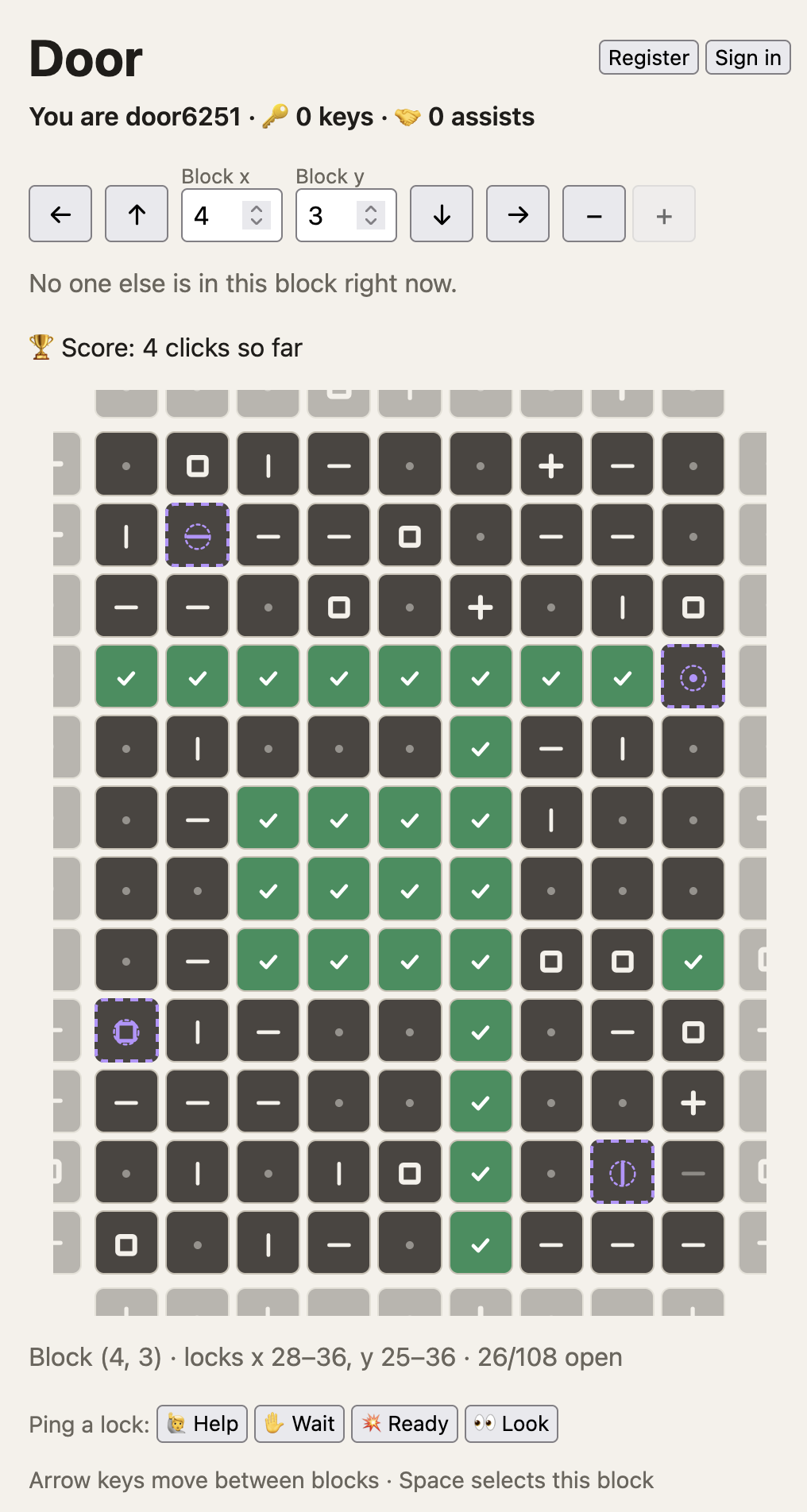
I'm also writing a puzzle game with a door that has one million locks. It's real-time multiplayer; some locks have opening combos, and others can be opened only by > 2 players. I'm writing it to practice with PostgreSQL. I only have an HTML prototype to test it. https://6251.s3.eu-west-1.amazonaws.com/hn-door-screenshot.p.... If you are interested, I can publish the code.
Last week, YouTube introduced GIFs in comments, so added an option to stop them from autoplaying and play them on demand (a play button).
Disclaimer: I posted a Show HN when launched the 1.0, but it didn’t get traction: https://news.ycombinator.com/item?id=49829812
In both of these projects, I'm trying my best to find a balance on AI usage. So far, they both have held strongly to the principle of only accepting code I've written personally. At the same time, as I begin to land on stable design decisions I've found that speculative experiments with AI can be helpful. I can benchmark potential future decisions prior to committing.
I'm not saying that AI couldn't be used to do more, but I'm trying to ride a line where things still feel personal, local, and deeply my own design. And more than that, I'm practicing holding on to the joy in the work. It's too easy to just know that AI could be used to plow through a problem. It makes my scope tend to creep and my estimates shrink. So, pushing back involves continuing to scope small changes and remembering to feel positive about each win.
It's harder than it should be to compare old pcs for home labbing so I've been building this to scratch my own itch. Right now it's more focused on specs but I'm working on expanding out to to include things like viable upgrades and explaining the different model lineups.
No subscription, pay-per-use to allow your AI to access the best tools.
This player runs in a browser and lets you play two audio tracks from the same movie on different devices.
It doesn't require installation or an account and the movie doesn't leave your computer.
v1 didn't have a desktop app with sync, so I added one. I also redesigned the whole web app (a few pages are same as old design but I might change those later)
Honestly, I rewrote almost everything. I've been using it myself since the first alpha, and the v2 release candidates feel like a different app.
It still has some rough edges, so I got a friend to run it on his server as a tester which made finding bugs a lot easier.
Feedback is very welcome, it is my first project: https://github.com/itsmeares/staaash
Because I can. Well, let's be honest: because LLMs can. There's nothing particularly novel about this. It's just wiring a bunch of libraries together. Certainly would have been time consuming, but not difficult, strictly speaking, since all the heavy lifting is done by the libraries utilised.
Likely going to migrate https://breaka.club HUDs and editor UI to React since Godot control nodes are by no means impossible to work with, but somewhat cumbersome.
EDIT: Oh, will be open source like a lot of Breaka Club's other libraries very soon. Still optimising.
1. There's some stuff simply not well optimized internally. Working on these now e.g. there's unnecessary internal hierarchy on all nodes that only needs to exist on a small subset (related to border boxes, overflow etc.)
2. Eager shader compilation. There's some glass and blur shaders that are compiled on load. These really shouldn't be.
3. Godot 4.x on the web is always pretty slow to load. Time of first contentful paint (if you ignore loading screens) is nasty across the board. Godot 4.8 upgraded Emscripten, so there's actually potential to improve this quite a bit since it's now easier to dynamically load WASM (which is what we're doing extensively here). I'm unaware of any work on this upstream though.
4. THE BIG ONE. This demo is a bit of a monolithic beast. It doesn't just include Godot's implementation of React. You can reveal the code for any page in the demo, and edit the code live with an inline text editor. Genuinely bundled in this demo is a full TypeScript 7 implementation (based on Bun's Rust implementation) that type checks and compiles code to JS on the fly, and hot swaps components on the page live.
For the most part, this isn't designed as a performance demonstration, although there is a small section on repaints/relayouts. It's mostly just a demonstration of what's possible with the library.
Realistically, there's also the fact this is React. Its architecture is based on React Fabric (like React Native), so runtime performance should be pretty decent. But frankly, it's never going to be as performant as some alternatives — it's not really the primary goal of the project. I'm considering an alternate SolidJS front-end for improved runtime performance, but that'll do nothing for first load time, unfortunately.
7 months ago I left my job to give more time to Zoupyu. Solo building and figuring out everything from SEO, marketing, tech, design, and everything else it takes to build and run an online product. I never sold anything in my life before and now we have around 50 paying customers from all around the world, just 3 months ago my goal in life was to make one sale just one! and now its around 50. I know its not much but feels so good that I achived that. That too all organic.
Most USB microscopes come with poor software, often limited to one brand or operating system. G-Scope works with almost any UVC microscope and several Wi-Fi models too, it has photo/video capture, calibrated measurements, annotations, and more advanced features like panorama stitching and PDF reports. Some pro features require a one-time purchase.
Everything is local, without account, no subscription, cloud or telemetry.
After every update the github pages is rebuilt with the new data, so you can see some trends in there with some aggs and nice charts. Also, had some fun to build a clippy clone with an in browser SLM.
This weekend I am modifying the pipelines to be able to operate on downsampled sensor layers so that I can get multi shot editing as snappy as possible. If you are only displaying 500ish pixels wide, its wild to still be rendering the full 16mp image. Perfetto has been very helpful while optimizing.
Last weekend I was able to make what I feel like is a generational leap in reducing the noise from these sensors. https://www.dpreview.com/forums/threads/foveonic-process-you...
Up next is redoing the caching/scheduling architecture to reduce the amount of overhead and to support multiplexing downsampled editing so that the images are processed within the same GPU pass instead of N passes * M images serially.
an agentic logo generation service that vectorizes into high quality brand assets and gives you a complete package (including favicons, OG images, etc.): https://mklogo.sh/
and a PKMS for macOS with a chat-first interface, allowing you to store any link and chat with your library/knowledge graph, automatically file and categorize it, and more: https://gleanary.app/
When playing Zwift, Rouvy, etc, I find that I get too competitive and ruin longer workouts by trying to keep up with or sprint past people who are much faster than me over long distances.
This is bad for building stamina and endurance, but I get bored, and it's hard to fight boredom and physical strain both at once.
I do not get bored sitting in front of Balatro, Raccoin, Tetris - anything with bright colours and satisfying noises and combos.
The first finished prototype game is very simple: you sort coloured marbles. Higher watt output from the bike means marbles are blown, by wind, upwards as they roll across the screen. Lower watt output means they fall. Steady watt output means they move horizontally. Marble goes into correct hole -> satisfying noise. It rewards steady watt output over time, with minor adjustments, which is what I'm trying to work on right now.
I was pretty amazed by how engaging I found it (total iPad baby brain). The miles really fly by - I get tired before I get bored.
I think that next I'll either do a tower defence game, or a less-dopamine-rewarding game in the style of Kerbal Space Program. Taking your actual weight and watt output, putting a bike with wings into a physics engine, and the gameplay loop being unlocking increasingly large airplane pieces, and designing - then flying - increasingly ridiculous airborne bicycles seems like a compelling idea, though less good for fitness.
The control surface being so limited - essentially one measurement which can either go up or down - is a really fun constraint for creativity.
There’s an open source “recomp” of Gran Turismo 3 that supposedly works pretty well on a laptop. I kinda want to hook it up so that the Zwift ride provides the power output for the car.
If 1w = 1hp then I could probably win some of the first career races right now. And if I get back in shape, I could eventually hang with the base model WRX’s.
I'd love to try a similar approach to gamifying exercise on a smart watch. That's an even more fun problem, because (when running, for example) you don't even have a constantly-present screen to communicate dopamine to the player with. Perhaps some watches wouldn't even be able to provide sound feedback? I've never owned one. It's a really interesting constraint for game design.
I thought I’d get where I wanted much faster, but it turns out I ran into quite a few challenges: it’s quick to build something simple, but it takes much longer to get a reader that’s robust and pleasant to use (extraction, parsing, security, infrastructure, etc.).
On the tech side, I’m using my usual stack, Laravel and Livewire, with some Python for extraction and Go for the email infrastructure. This month I’m working on the beta release, since several people around me were already using it, so I’d like to gather more feedback.
[1]: Predictions are LLM-powered largely to more reliably consume the free-text descriptions in traditional (e.g., NWS) weather forecasts of predicted high and low cloud cover around sunset.
This month, besides promoting and improving the app, I've had to spend time defending it: bots used the SMS login to trigger 1,744 code requests in nine days. Only three of them ended in a sign-in. I have since added several defenses, including a daily check that compares codes sent and sign-ins per country. None of this fixes the app's core problem. Open the map before any of your friends use the app and you find it almost empty.
https://www.orbitome.com/?utm_source=hn&utm_medium=community...
It's aimed at people who enjoy DnD, and I took inspiration from the Necronomnomnom. All the recipes are narrated by a different character.
I'm tinkering on a project to take two contestants and dump them into a reasonably nicely equipped linux environment (checkpointed fly.io Sprites), giving them a task, and watching them compete in real time to see who gets it done first. All of it streams to twitch.
Here's an example match (I have two agents pretending to be contestants for the sake of the demo: https://www.twitch.tv/videos/2923688013). Basically anything goes; I imagine people will clone+stow their dotfiles, leverage their workflows/harnesses/editor configs, etc. Viewers will get to see how its done.
Next on the todo list is "weight classes" that let contestants compete with a fixed level of harness capability: natty means no agents at all, small local open weight LLM tier only (qwen, gemma, etc), large open weight models only (deepseek, glm, kimi), frontier lite (haiku, luna), frontier (6.1-sol, haiku), frontier plus (astra, fable).
Ultimately I want to rank users in each weight class so people can compete for delivering the most at various cost tiers.
It's accumulated a decent number of users now which is exciting.
Under the hood it's an Elixir backend with a network of little go probes running all over the world, all connected by TCP tunnels. All the check result data is stored in Clickhouse. Status pages are generated on demand and served through a CDN.
The whole thing is EU hosted.
Trying to make it fun for both normal players and engineers as well.
Would be super happy if you'd check it out: https://podium.do
It has an integrated dashboard for what to review, integrated symbol understanding, a clear split of reviewed/unreviewed files, and a result diff view (which shows me only how files are going to look in the end).
I'm almost not opening Github these days.
Working on an in-browser update of our k8s course, a new C course, as well as terraform and bash courses coming down the pipe.
I felt like all of the plumbing to build agents was insane to get to a hello world state. I just wanted to connect my conversation UI to my API. Hence this product.
I got overwhelmed by walls of text of parallel Claude Code sessions. This limited the sessions I could steer in parallel to maybe 5 or 6. I knew there had to be a better way, and I found one: A canvas per project. Work laid out as cards. An agent in a worktree per card. Chat condensed to WhatsApp-style back and forth, not a litany of tool calls. Result is usually a narrated demo video that I can comment on by voice to have the agent go another round. Remote-control from my phone. Remote workers to scale beyond my machine. Everyone I know who tried it has stuck with it so far.
The site is static, built with Astro. When it came time to host it, I didn't like any of the Japanese options. I could have put it on Cloudflare, but hosting a directory of Japanese alternatives on an American CDN felt a bit off. So I started building my own static hosting service: Kamakiri Pages [2]. It's CLI-first.
Note: AltStack.jp isn't hosted on Kamakiri Pages yet. I plan to switch it over within the next two weeks.
Feedback welcome on both, especially if you know of services that should be listed.
From what I can tell, we’re about even with the current state of the art in academic publications right now, at least on MDB. Runs faster than real time in pytorch on a few years old MacBook.
It even does a decent job creating easy/medium/hard versions from the original “expert” track. I compared ours to some charts from Rhythmverse and while we’re not as good as the official ones, we’re pretty darn close.
Spent some time trying to extract an instrument model for the drum sounds from the recording too, but I think that simply requires too much data for lots of the songs that I like where the mix is really dense with a ton of sound from distorted guitars and cymbals etc. Works a treat on super clean mixes like Back In Black though.
Next step is probably to create my own rhythm game, since my initial experience with Clone Hero and YARG left a lot to be desired.
Since then I wanted to develop further such a game, and now I'm almost ready to release https://ultimidi.com , check it out, it's not really a rhythm game, but my goal is to add more mini-games to it (including rhythm games) and more instruments (now has piano, but planning to add guitar, ukulele too, not sure if drums would work too).
If any one is curious, it's on https://dumplingmoney.com/
Q: are transactions attached to individual accounts? Or does your app have a virtual global account?
Good times, but lots of foundational math I hadn't previously been exposed to.
Some reading material if anyone else is interested in that:
Spiking Graph Convolutional Networks (2022): https://doi.org/10.24963/ijcai.2022/338
A Tutorial on Spectral Clustering (2007): https://doi.org/10.1007/s11222-007-9033-z
Semi-Supervised Clustering with Graph Convolutional Networks (2017): https://arxiv.org/abs/1609.02907
Spectral and Algebraic Graph Theory (2025, draft book): http://cs-www.cs.yale.edu/homes/spielman/sagt/sagt.pdf
I building a service to let different AI agents talk to each other. You can use it to connect your own agents, e.g. Muse and Grok Bot, or make Claude review Codex’s work. Or you can use it to connect to your friend’s or colleague’s agents - think Grok Bot team but without the requirements that everyone has to be part of the same org.
Why not use mail? Well, for one, it’s hard to register many different emails programmatically, and you do want a separate inbox for each of your agents. And you shouldn’t really give your agents access to your primary email: it’s not secure, and you will be drowned in noise past a certain email volume.
There is a lot of competition in this space already; it’s heating up. Wish me luck!
Project #1: The first project is MiSTerVision, a CRT-friendly Jellyfin and Plex client for MiSTer FPGA built in Go. I have a MiSTer FPGA connected to a late model Sony Trinitron CRT and wanted to watch movies and shows I've ripped to my Plex server.
I originally contributed PRs to the MiSTerFin project, a Jellyfin client for MiSTer, but the project was stagnant so I forked it, ported it to Go, and was off to the races. I added Plex support, improved the UX, improved performance, filled in a bunch of compatibility gaps in the Jellyfin support, and released it for use by anyone with a MiSTer.
Watching old-school cartoons, like Dungeons and Dragons (my favorite) on a 4x3 CRT in better fidelity than I ever had as a kid is sublime. It's had 25 or so public releases over the last few months.
https://github.com/trentnix/mistervision
Project #2: The second project is HyperServer. HyperServer is a Go framework for server-rendered apps with HTMX that I've been working on off and on for a few years. I was originally inspired by Pagoda and really like the architecture and ambition of Pagoda but didn't like its dependence on third-party libraries.
HyperServer uses standard net/http handlers and html/template, requires no ORM, and makes authentication, sessions, and storage optional. It’s intended as a reusable library rather than a starter repository you copy.
I haven't been confident enough to make a "release" for it yet, so it's labeled as "experimental". But I have built a functional (and fast) blog on it. I plan to use it as a platform for a couple of other web projects I'm scheming. Hopefully that will prove its utility and I'll make an "official" release.
That said, anyone interested can peruse it and use it as-is. Any feedback would be welcome.
I also consider doing own devices in the future. Providing an affordable solution for everyone.
Project is Rust + Slint.
If someone is interested in changing the smart home scene my email is in my profile!
Right now it's a python library, but the vision is to build a new framework / SDK / programming language which allows you to seamlessly mesh "plain old code" with LLM evaluations, while having a runtime which does "smart" context engineering in the background in order to steer the LLM and improve its correctness.
The end-goal is for this paradigm to enable new kinds of agentic applications, which leverage the flexibility of LLMs while retaining the determinism of regular code.
You can even manage your business on your WhatsApp! You receive your weekly report in your phone directly and you approve or edit anything that goes online (because yes, AI is not perfect yet).
We launched recently and are polishing everything while finding the optimal verticals (if you guys know WHERE would you use it, let me know!).
I also made some improvements to my support workflow app, Support Toolbox [2], but haven't released those yet (hopefully this week). It now also includes text expansion, which I was really missing from my workflow and had been using another app for previously. At this point, it does pretty much everything I need it to do. There are some smaller improvements I need to make, but even if no one else ever starts using it, it helps me tremendously at my day job!
[1] - https://gorby.app/
Classifieds.fyi (https://classifieds.fyi) - A way to create private, invite-only classifieds for your community. Supports buying/selling, job boards, and vacation rentals, with support for housing coming soon.
A Tauri 2 CLI / MCP that allows your agent to debug, take screenshots, run JS, etc. inside a Tauri app: https://hypothesi.github.io/mcp-server-tauri/
I'm using Herdr to run multiple agents in parallel, and my goal is to see whether I can get them to collaborate more efficiently.
For example, when one agent's PR gets merged, other agents immediately become aware of it, rebase their own PRs and fix conflicts.
What also often happens is that new tangential requirements and sidequests often arise while working in a session, and I now let agents hand these off to parallel Herdr tabs. The handoff can be done with or without XMPP. These parallel agents announce their statuses in the XMPP MUC (groupchat), which enables them to coordinate.
Technical details:
Converse XMPP client runs as a headless NodeJS daemon with a CLI that can be called by agents.
I created a /coordination skill which is enabled by default via a Claude Code hook. When an agent starts, it ensures the Converse daemon is running and then joins a password-restricted and members-only MUC where all the other agents in that Herdr workspace are as well (and also myself). I can then assign that agent tasks via messages in XMPP (DMs or groupchat) or from Claude Code.
Once the agent has the task, it announces it in the MUC so that other agents are made aware. When sidequests or requirements arise in that session, it can ask in the MUC whether other agents are idle and able to take over that parallel task.
I've been building the Converse daemon and CLI and have now been experimenting with the workflow and working out various kinks and use-cases.
There are various other XMPP features that can be explored further. I'm thinking of using PubSub with a web UI with vertical swimlanes which can show me which agents are currently active, what they're working on and for how long.
I'm using Claude Code because that's what we use at $WORK, but this should be independent of any harness and part of the point is create neutral tools not locked into any particular inference provider.
Will remain free, planning to add some kindof mailing list for alerts when birds are spotted in areas of interest.
After iterating on many agent built C++ compilers, I now have a version that compiles about 4x faster than GCC and Clang[3]. I think i can extend the same approach to rust. I'm still a ways from the rust self-hosting stage but early results are promising.
[1]: https://github.com/vishvananda/cppgm-extended
[2]: https://medium.com/@vishvananda/i-spent-2-billion-tokens-wri...
[3]: https://medium.com/@vishvananda/how-i-built-a-compiler-that-...
Over the years, I've used spaced repetition to learn things and to remember them. But the material for my flashcards came from everywhere: books on Google Drive, blog posts in a bookmark manager, Kindle highlights, Wikipedia, and notes spread across email and notebooks. The cards were in one app and their sources were in five others. This was overwhelming so I'm building dushed. You can access all your knowledge sources(bookmarks, feeds, Kindle highlights, files, flashcards, etc) in one place and also link sources to one another.
Traditionally these kind of machines would use a PLC, and then get connected to Scada and Internet, but that's expensive.
We have built Linux based controller that can extend into any number of AO, AI, DI, DO inputs and control the machine. It's very cost effective, and unlocks a lower bottom of the market that before didn't even dream about installing connectivity inside each machine.
Our first project is https://waboost.com/
It's a water treatment machine, and we are looking for more clients.
Right now we are talking to grain separator company, and one fertigation company.
Stack: Go for Cloud and machine backend React for Cloud and Machine UI
Pretty minimalistic
I have 10 years of experience as an attorney doing mostly dispute resolution. And about 15 years in software development. Liitmik is the product of these two.
* https://unofax.com - A simple a la carte fax service
* https://unopost.com.au - A way to send physical mail online (and avoid standing in line at the post office)
* https://snailgram.com.au - Custom greeting cards, with the message inside written by a 3D printer holding a pen.
There are a handful of others too, but these are the ones that are live so far. I've contributed between 5-40% to these projects.
I've been trying to improve agent knowledge over a codebase, and existing approaches weren't giving the result I wanted, and I wanted to keep it simple. In the end, I added a semantic layer on top of an LLM Wiki and it saved 30% of token usage in multiple benchmarks I ran. It also adds some nice features to deal with concurring agents updating the shared memory, to ensure all information there is reliable and fresh.
It's published to PyPi, so an "uv tool install wayfinder-memory" already does all the work, and it's compatible with almost all Harnesses.
The codebase memory knowledge graph should be maintained alongside the codebase whenever possible, which basically means checking the graph into the repo alongside the code, or some other architecture that has an equivalent effect. But then it complicates the design of the retrieval indexing; I think your SQLite rebuild idea might work for that though.
I have a question for your design: since your knowledge graph is checked into Git and therefore Git worktrees should already isolate them and resolve conflicts between branches, why did you include the section about concurrent agents as well? Is that for maintaining the SQLite index which is not checked in?
There are lots of these projects around the internet but I found them to be hard for an electronics noob like me, and so I put the modules back in one of the "will fix later" drawers. With the current state of AI I decided to give it a go.
My Fluke and me did some measurements and Claude did the hard work afterwards. Prototype worked on a breadboard so I let it cook further and now I've got some PCBs coming in from China.
Still got a lot of respect for soldering some (quite large) SMD components but I think I'll get it done.
My plan is to revive as many modules as possible (got around 30) and build clocks from them to gift away to family and friends.
Built with Kotlin/Spring Boot/React/PostgreSQL, because boring works well.
Also, bulding a marketing tool to help local businesses be ranked by ChatGPT: https://www.pluspoint.io/
Secure and private AI agents. Declare behaviours of workflows and agencies in YAML, that uses local LLM models.
You can export the workflow to Docker, Kubernetes, ISO, or binary, with the local llamafile or gguf model pre-baked. Or just run locally.
Just this year, it now includes an agent-loop CLI for coding tasks using local LLM models, alternative to mainstream ones.
Project GHA harvests daily llamafile, gguf and openrouter free models you can use. (In the agent-loop CLI, you type /model).
I'm revisiting the Netflix Prize challenge with LLM. So far I've hit the 9% improvement mark within a couple weeks. I seem to have hit a wall in the last week or so with no further progress. I'm hopeful to hit the 10% goal with one of the many experimentations though.
- https://github.com/garlab/gloss | `brew install garlab/tap/gloss`: render markdown, sources, images, chess and go (game) records in the terminal. It's built for libghostty but fallback on other terms.
- Turingo: https://turingo.net
AI detection based on writing process and not the final draft. It tracks unusual changes, including pastes, throughout the full revision history, giving teachers a clearer picture of how much AI text is there at any time. The idea is to help them have a conversation with a student before jumping to accusations.
An AI agent that learns how you write code. It reads your repo and automatically extracts DSL recipes from the way you structure endpoints, handle data access, write workers, use queues, and organize tests. Those recipes can combine across stacks and patterns into millions of variations. The goal is to make the code generation as deterministic as possible, cutting the token usage and agent wall-time substantially, while following your code conventions.You start from an empty Python file and write the model yourself: a tokenizer, a bigram model, attention, a Transformer. At the end, published open weights run on your own code. Tests check each step before you move on.
Try it: https://try.modelmathics.com (or ssh try.modelmathics.com)
The rest runs in mm, a terminal app, with your code in files on your machine. Stage 1 (11 lessons) is live as a free private beta.
Feedback is very welcome.
It supports 19 languages, and comes with a lot of built-in RSS news and podcasts feeds, though power users can add their own. You can play audio and follow along word by word.
I’m looking for more beta testers at the moment. You can sign up at https://BilingualBulletin.com. It requires iOS 26.
I’m curious if anyone else has been building on the Apple Foundation Models or other onboard AI frameworks? They’re surprisingly powerful, but with weird limitations sometimes.
The platform isn't ready for real usage yet. I keep reworking the "course" (I curated the first 150 concepts because the most frequent concepts in native material don't make a great intro to the language).
I'm scraping lots of content and improving the analyzer (breaking a sentence down into the concepts needed to understand it) right now!
I love talking about language learning! If you're interested in the platform let me know at will @ <the domain>.
It is a super competitive area but will try to find a niche and bring the project up on Google.
I have a regular 9 to 5 job, two kids and a dog. Doing this in my spare time at the moment. The goal is to complete the website until the end of the month and it is a marketing game after that.
I'm working on Levithas (https://levithas.app): stop consuming, start skilling.
I want to go against doom-scrolling and passive consumption of content. Learning a skill is about staying curious. It builds confidence, gives you something to impress others with, and makes you a more interesting person.
It is not just software, it is a movement, a lifestyle to get our life back.
It’s been getting a decent number of sign ups despite me not really posting it anywhere or doing any marketing.
Ultimately a fun project, and useful for myself and a few friends, so I’m happy others are even interested in trying it.
I’ve started to regret using Phoenix LiveView, as it’s only deployed in one region, so high latency far from there. I’m exploring a SPA as a better alternative.
Otherwise, I’ve been playing around with a Lua engine to build feeds for websites that don’t support them, using AI to build the Lua as a once-off. It works reasonably well, but isn’t ready for prime time just yet.
It’s always been a hobby to get people socialising/connecting more, and I’ve been wanting to build something that can put Convex (almost like Firebase) to good use since discovering it.
I relaunched it on HN [2] just over a month ago after working on features over the last year or so and landing a ton of useful feedback, which I've mostly now acted on. Could and should probably do more marketing so that's my short term focus.
Likely the next phase of work I'll be exploring is potentially open sourcing and federation - super excited about this but it'll likely need a fair bit of research and planning.
I've been working on it for almost a year now. I started out adding lots of features, but over time I've become more interested in keeping things simple, improving the code and avoiding unnecessary complexity.
Use this to quickly get sleepy without taking any medicinal pill or long form meditation type things (It is as short as 7-minute session).
Easy to use. Simply close your eyes and imagine the micro-scenarios you hear. Like if you hear "moonlight on a white flower", imagine that scenario until you hear the next one.
You may also use it to break nightly doomscrolling habit. Try this tonight! (and any suggestion to improve it?)
I noticed that the later prompts tended to feel a bit irregular in their English: “Pebbles on bottom of stream” is one that I remember; “bird in small nest” might be another. “Pebbles on the bottom of a stream”, and “A bird in a small nest” would have sounded more natural.
I may be a little outside your target user base: I tend to fall asleep very quickly. (I joke to my spouse that by default I don’t have much happening in my head, and when it’s time to sleep, I just “listen to the dial tone.”)
One parting thought; I was pretty skeptical when I first started listening, and about halfway through I was gamely doing the visualizations, but mentally rolling my eyes (“This would never work!”). Around the 5 minute mark I noticed that I was in a fairly meditative state, and the app could have told me to imagine I was a being of light and I probably would have.
Around the 6 minute mark I noticed that I wasn’t really paying attention to the prompts at all; and I think it was only the weirdness of the English of the prompts around that time that kept me awake.
Overall a little weird, a little fun. Thanks for building and sharing it!
I use it with GPT Luna and Haiku (project being local, you add whatever API provider you prefer, with your own key), and both proven smart enough and dirt cheap.
In my app Notes are all one liner, and it supports minimum Markdown, it can manage tasks, reminders, do inline calculations, unlimited undo/redo. Notes can organize by project and categories. Data is stored as simple text file.
https://mtarin.com/projects/nift/
Core point is simplicity, and frictionless note taking, high performance, and be open in nature. And, to build a framework that will provide ways to manage notes in many different ways. Like I have plans for kanban, Eisenhower matrix, back-linking, bookmark manager, time-tracking, etc. All from a single place, without fiddling with mouse, or any UI that stops me from writing my thoughts, or using my muscle memory.
I am looking for feedback, and wondering what would make people actually interested to buying this. The demo versions are feature complete, except it wont save to file.
It's completely hand written, no AI assisted code.
Started it mainly as a way to use AI and I named it after my dog to immortalise him: https://play.google.com/store/apps/details?id=com.gads.hamil...
I also priced it cheap with no recurring fees.
I built it for a street photographer friend so he could let people in his photos download their photos when available, and also get their permission to publish them. There is a version without without multi-user requirements under my GH: https://github.com/hikmet/people-in-photos
Started with a funny experiment, to have a CLI that can spin up a server (ServUO, Sphere, whatever), then deploy it somewhere (local, VPS, or Railway). Then saw interesting stuff that people did on top of existing ClassicUO, and decided to extend CLI's capabilities to client area too. So, I was able to deploy a server and a web-client (that you can open a webpage and play the game without the actual client installed on your machine). This was a significant step because running UO on macOS is always a struggle. Then I decided to add player-like bots so that the server doesn't feel so lonely. Started with some local decision trees, when it failed I hooked it up with Jev and Clef. Also added Haiku for speech generation.
While doing this, I realized I need to find some game content (gumps, tile or item data, animations, etc). Similar to UO client, running UOFiddler on macOS is also another struggle. So I decided to port it to web.
If you're into Ultima Online, these two are open source, you might want to take a look at them:
There's also a Chrome extension: https://chromewebstore.google.com/detail/mind-the-link/faebh...
Your feedback is much appreciated!
Right now, I'm busy with marketing, so there's not much code stuff I can tell you. But here are some marketing finds:
1. At this point, ChatGPT traffic is competing with paid traffic, while having a much better audience quality and retention.
2. I had a disastrous Product Hunt launch, despite having two badges on previous launches. It seems like the platform went into "dead internet theory" territory. I wrote a rant about it here: https://www.brachkow.com/notes/you-should-put-less-effort-in...
And as for code, right now I'm busy with hobby projects, and two of them are:
1. v4 of my Inertia.js adapter for the Hono framework – https://github.com/brachkow/hono-inertia/pull/6
I want to expand the thing I made to write Things To Have without relying on annoying "full-stack" frameworks, into:
- the best Inertia adapter for Hono
- the best way to do SSR in Vue (or whatever framework you use)
If you don't know what Inertia is, check it out, as it may change your frontend life – https://inertiajs.com/, and Hono is modern express.js – https://hono.dev/
2. I'm building a mobile multiplexer because every one I tried was either too old-fashioned or low quality.
Now I've built a great app with good scrolling, good composing, simple use of hotkeys, file sharing, and many, many QoL features. I'm really using it on the go almost daily across two months now.
The only thing that slightly set me back is that I went too deep into supporting the herdr-tui protocol, and herdr moved into a new protocol that I'm not fond of.
I was experiencing some friction with Orgzly Revived and thought I'll build my own and it just grew. The latest update adds support for attachments and renders images inline.
Do give it a try if you have an Android phone. The app has a ton of features. Some of the highlights are:
- Capture templates
- app shortcuts with easy access to capture templates
- notify of sync conflicts and offer a way to resolve them by picking on of the revisions or merging both
- a customizable agenda that shows overdue, due soon and upcoming events
- add tasks from the agenda widget using the quick add overlay
- refile tasks by drilling down into files and headings or just searching for them
- auto archive done tasks so that you don't have to clean them up manually
- attachments can be added to notes which complies with org-attach. And images are rendered inline with support for setting the width
There are a lot more features than what's mentioned here and more to come.
Here's the GitHub repo: https://github.com/rrajath/bloom Play Store: https://play.google.com/store/apps/details?id=com.rrajath.gr... F-Droid: https://f-droid.org/packages/com.rrajath.grove
Fastest way to get updates is via Obtainium or GitHub releases.
And I did: https://hourbun.com/
Just an intuitive and fast time tracking and invoicing app built for people and teams like me who want a quick and reliable way of invoicing clients without paying a premium or suffer through bad UI/UX.
I just released a small-but-difficult low density set which I like a lot. I’m starting work on larger puzzles (second or third attempt).
Screens and download: https://lab174.com/nonoverse/
There is also a daily puzzle at: https://lab174.com/nonodle/
You can share a group with your friends' phones over Wi-Fi or Bluetooth: you pair with a QR code, it's end-to-end encrypted and no server is involved. You can also add an expense by voice or by reading a receipt with the camera.
Now working on 2.4: a simpler way to invite people into a group, and settling up with the fewest payments.
https://duea.page/caravella/ · source: https://github.com/calca/caravella
Feedback is welcome, especially on sync.
For 4+ years I've been working on a game programming language which makes your game multiplayer automatically! Every program written in Easel is guaranteed deterministic and snapshottable, which it uses to automatically perform rollback netcode. The rollback is incremental, it automatically stores deltas of only what has changed using a copy-on-write mechanism, so it's really efficient for games where your players are walking around large worlds which are mostly sleeping except when the player is nearby.
The idea is that I hope teenagers who love to play multiplayer games, would find this to be the easiest way to code a multiplayer game by far since the multiplayer is automatic. Learning to code could be much more fun because they can make games that involve their friends, classmates, brothers/sisters, parents, or just anyone online. Maybe especially more important for raw coding to be fun and engaging in the age of AI.
This month I'm making the multiplayer even more efficient so people really can just code large multiplayer games without worrying about it, which I think is important for beginner coders.
It scans your codebase, turns it into permanent c4 & sequence diagrams and keeps them up to date on each commit. Then, instead of reviewing a 10k line coding PR, you review a 30 line change to sequence and C4 diagrams.
npm i -g @archme/cli && archme init to run it on your own computer, code never leaves your machine.
DailySelfTrack: https://dailyselftrack.com/
I've also built a starter template for Astro which is light, performsnt, non-bloated and scalable. It uses markdown / MDX for content, plain CSS with styling tokens defined in a var.css, and other things I would use for ever web project. It's very good for blogs also, none of the usual UI and UX problems many blogs often have.
Astro Starter Template: https://starter.bryanhogan.com/
Then also HNowledge[1], a free iOS app for browsing the HN stories and comments I've upvoted. Made it to fit the way I browse HN, which is upvoting mainly what I find interesting and may want to come back to. The app lets you browse by date, domain or score, add notes and export. Apart from syncing your upvotes from HN, everything stays local without any tracking.
[1]: https://apps.apple.com/us/app/hnowledge/id6813417548
Wanes[2], an Apple Health logging interface for tracking how long symptoms last. I tend to have headaches quite often and the way Apple lets you enter that data is pretty limited, so I created an app which starts a Live Activity for one or more symptoms using widgets, Control Center or Siri. You can change the severity rating while it runs and stop it from wherever you are on your phone (Home Screen, Lock Screen, Dynamic Island, Siri).
For me the coolest part is that it's claude's memory, so it actually develops a self identity too and gets to know you better over time. So that opens up new things, like I wanted to keep session cache from expiring so I just told it "when I type ping, just reply with pong" and because I used it several times that day, it automatically strengthened the memory and now it just does it. And if i stop doing it for long enough, it'll automatically fade away.
No stale files, no hundreds of md docs, and what it knows about me isn't limited to the 1 page built in memory file (both work great together btw, no need to choose). It's free, open source, and totally local, no api keys.
I have a PAL-2 [1] (a modern KIM-1 re-creation) and started learning 6502 by entering programs from The First Book of KIM [2].
I wanted to be able to compile/link the assembly from the book so leaned on Claude to set up a 6502 dev environment for my Mac. I put everything needed (and instructions) on GitHub [3].
(Claude also has been helpful in re-formatting the 6502 code from The First Book of KIM into a more modern style compatible with modern assemblers. A few of these modernized programs I added to the GitHub repo above.)
As it happens, I am also fixing/formatting The First Book of KIM by recreating it in a modern page-layout app (Affinity Publisher). The PDF scans that are out there are not pretty, have OCR errors (and the book itself has mistakes). Hopefully I'll have a new version of the book/PDF out on the internet by the year's end.
[1] https://www.tindie.com/products/kim1/pal-2-a-mos-6502-powere...
Recently added new high-res maps, a timeline, and country names and borders.
For example, see Pangaea:
https://dinosaurpictures.org/ancient-earth?borders=on&names=...
Building a working CAD software based on my own geometry kernel, Aetheris.
https://github.com/yuechen-li-dev/HeliosCAD
Since it's code based CAD for LLMs first and foremost, I'm trying to add visual programming into the UI, as well a new way of drafting that's closer to how mechanical engineers actually do sketching called IntelliDraft.
Other is the Concept programming language, as a successor language to C++, based off the idea of C++20 concepts, with templates, comptime, Einstein tensors, async/await, explicit state machines, CPU inference, Vulkan, easy C interop, and safety proofs built into the language itself.
https://github.com/yuechen-li-dev/Concept/
Currently still compiles to C11, self hosting is in progress and targeting AMD64 right now, but it'll be a while before finished since this is a difficult project even for frontier LLMs.
https://github.com/yuechen-li-dev/Aetheris
Aetheris is focused on performance and reliability first and foremost, because I'm just so tired of SolidWorks eating up gigabytes of RAM for simple parts and crashing randomly. So, tge (almost) pure analytical geometry engine with aggressive optimization means it is faster in terms of building 3D models, but the trade-off is that it doesn't let you do weird modeling like asymmetrical/variable radius fillets.
The interesting I noticed is that in the process of curating and organizing my photos, I stumble across memories and moments that I had completely forgot.
Development Challenge: The app does two interesting things underneath the hood... First, given an arbitrary number of thumbnails with different aspect ratios, it finds the best sized rectangle that completely fits all the photos. This allows me to recursively stitch groups together and always output a rectangular thumbnail for the group. Second, the pinch/zoom UI uses these nested thumbnails directly without slicing/dicing to fixed sized tiles.
Want to try it out? Just copy and paste the url to your agent and say "build me an app".
It was about what happens if Eternal Vault itself shuts down where people are putting their trust in something to be there when the time comes when they are no more and their trusted contacts wants to unlock their vault.
We chatted on reddit, and I majorly worked towards making it all work even if Eternal Vault went under someday (I hope it doesn't)
This is what I am thinking about: https://eternalvault.app/continuity/
The goal was to have a basic pokemon themed tamagotchi clone with step counting that motivated me to walk more. It snowballed into a full fledged rust port of the whole game, with a completely redesigned UI meant for round screens and touch controls. It's got bluetooth and wifi trading, autosave, contextual action buttons, etc.
The most experimental and interesting feature is an auto play mode, which keeps the game advancing while you walk in real life, letting you take over at any time and keeping a log of any interesting event along the way.
Not launched yet, but I have a very preliminar landing page for it here:
I discovered that a relatively inexpensive 0.6 mm italic nib from Manuscript's Creative Calligraphy set works well with my natural handwriting, it looks "good" even when I'm just starting out.
But it took me a few hundred dollars of trying different sized nibs to really understand that for nibs in general, stroke width variation is through pressure, "pulling" the nib in parallel, and I really needed a stub / italic / calligraphy nib where line variation is through the angle.
Also, that my handwriting is really small, and finding any stub nib below 1mm is hard, until you know that it comes with the Manuscript set.
Beware, fountain pens are a rabbit hole.
I got overwhelmed by walls of text of parallel Claude Code sessions. This limited the sessions I could steer in parallel to about 5. I knew there had to be a better way, and I found one: A canvas per project. Work laid out as cards. An agent in a worktree per card. Chat condensed to WhatsApp-style back and forth, not a litany of tool calls. Result is usually a narrated demo video that I can comment on by voice to have the agent go another round. Remote-control from my phone. Remote workers to scale beyond my machine. Everyone I know who tried it has stuck with it so far.
https://github.com/sadilek/obeya – looking for feedback!
It started because I wanted to get back into making games, a hobby I've struggled to find time for over the years. I wanted to give agents a goal, let them work for hours, and come back to something I can actually try and give feedback on.
I've since used it for game development, research, and building other tools, with some runs lasting over 20 hours.
It's still early and rough around the edges, but I'm having a lot of fun with it!
https://ramigb.github.io/epoptes/ And some footage of a game I am building -mainly- with Epoptes https://www.youtube.com/watch?v=1UEOr8B4Yfg
Slightly frustrated at the moment with what I think is a serviceable (if niche) product, but no uptake across marketing channels that I have tried. Discussing commercial products in topic-focused communities is forbidden.
On the plus side, my first client (oldest daughter, recently 8, learned to read via earlier versions of this software) just read Wildwood in one day. Her voracity as a reader is my ongoing validation. Whether or not this has been a financial and professional blunder, I can take some consolation in knowing that I hit this piece of parenting out of the park for my own girls.
maybe there is some more opportunity there. i know of some parents with kids struggling with reading today after being "left behind" during the pandemic. also, i have met a few adults in my time who couldn't read at all. it must be very frustrating to see software oriented toward very young children when trying to better oneself.
also, reading 550 some pages in a day might say something more about cognitive processing speed than reading comprehension
So I built Loop around the idea that agent results are the important unit of work, and you should be able to navigate them easily. The goal is to make interacting with agents via your phone feel familiar and intuitive based on the mobile UX we’ve all come to expect.
Loop runs on your own computer — no account, no server, no app store — and pairs using a Cloudflare quick-tunnel-generated QR code. It wraps the agents you already use (Codex, Claude Code, Pi, OpenCode, Antigravity, Muse Code, Grok Build, or any ACP agent), each keeping its own context, tools, sign-in and billing — local models through Pi or OpenCode work too.
GitHub is here: https://github.com/j-asefa/loop
I'd love feedback from anyone else who builds from a phone.
This keeps the tool calls low and it's fast enough to work in voice mode.
I made Jupjup (https://getjupjup.com) as a chrome and Firefox extension that lets you save words and phrases from all over and then do spaced repetition to remember them. My Korean has improved dramatically since I’ve started using it.
So I made 'Model Style not-a-Bench' to be able to quickly eyeball various LLMs, most preferably at 4-bit quants, under 100GB weights (excluding storage offloads like Qwen Flash Next's approach).
making it feel fun versus a basic quiz workflow is the hardest part.
Other than this, I'm playing with vibe-coding stuff I always wanted to do but never had the time/skills to do. For example, I built a TUI on top of beancount that is tailored to my needs and my business[2]. I also completely got rid of self-hosted plausible and umami analytics, and replaced them with vibe-coded built-in-rust (c) analytics tool that relies on both js-beacon and streaming of caddy access.log. Will probably publish about it in my blog soon, so subscribe to the RSS if you want.
Lastly, I'm messing with self-hosting. I completely ditched Github and Gitlab for self hosted forgejo + actions runner. I set up proper backup plan for everything I care (documents, immich library, my SaaS DB, and the forgejo repositories).
[2] https://kudmitry.com/articles/after-14-years-i-finally-built...
The loop is stable and responsive when receiving from 17 to 29.9999 Mhz, but not much below that... Almost got it
I find it to be a great way to practice singing/music.
Firefox: https://addons.mozilla.org/en-US/firefox/addon/karaoke-pitch...
Chrome: https://chromewebstore.google.com/detail/karaoke-pitch/facck...
https://github.com/djeastm/karaoke-pitch
The Firefox one has 40 average daily users and the Chrome one has 287 installs as of today.
There was a big jump in late October that might have had something to do with Halloween? I have no idea if people do karaoke more on Halloween. Still no ratings yet for either version, but maybe someday someone will.
I'm not really interested in making any money off of this site at any point but it has been fun to see the Google analytics data as a few dozen people visit it every week to read reviews. I've reviewed like 30 different brands at this point.
I’m currently in a beta phase giving people free access for feedback. If you’re prepping for interviews and want to give it a try let me know
It was born from the fact that whenever I prep for system design I spend a lot of time revising and learning material (as well as drawing from my experience) but whenever it came to the interview I just seemed to struggle to put that together to design the system I was given.
I’m a software developer and watercolor painter so my goal is to use real world painting techniques and have the results feel and look real.
Modeling the physics of paper, brush bristles, pigments, water, color mixing, drying in real time using gpu.
Built in rust using wgpu.
Currently looking for iPad beta testers if anyone is interested (supports Apple Pencil or finger).
Lemme know what you guys think and happy to provide a free month to you as beta testers!
I ended up rewriting all the inference in C++/CUDA and I'm finally getting close to limits on the devices I tested. The benchmarks are still a work in progress, I plan to add high resolution comparisons (1536^2 for images, and 1344x768 for video) to give insight in how well this scales.
One is https://bannedbookshelf.com which lists books that have been banned for whatever reason, or have been yanked off Amazon for being too ‘spicy’.
The other one is https://fangamesdb.com which tracks the decompilation and recompilation scene which is exploding now with AI reverse engineering tools.
https://robertderose.github.io/container-krun-runtime/
It’s an alternative VM engine that uses libkrun. The main purpose is that libkrun supports returning memory back to macOS when the VM releases it. It also has better performance in some areas, but it’s only been tested on my M1 laptop and I haven’t added nested support yet because I only have an M1
And https://robertderose.github.io/container-compose-plugin/
It’s a full docker system running inside Apple Container’s machines with automatic localhost port forwarding, automatic shutdown if nothing is running, and exposes a tcp socket so you can use most tools by just exporting your DOCKER_HOST environment variable.
I have a few other projects but they are still in earlier stages
A simple EU static and app hosting service: PodBy [2]. It was launched last week, and is at €10 MRR.
Thank you for asking and for your suggestions!
[1]: https://uruky.com
[2]: https://podby.com
It has been tough going, and not really found an audience yet, but would appreciate any thoughts / criticism's.
(Built using Elixir / Phoenix / Live-view / Cytoscape - an amazing stack for web / AI)
It's so amazing to have the ability to gather and parse publicly available scientific data and actually visualize it in real-time. It's one of those projects I'm learning a lot from and can keep going with (the universe is a big place :)). As a software developer for 20+ years, its been mind-blowing and often also frustrating to have Claude generate code that I deem good enough. About half of my time has actually been spent on refactoring, building quite some skills in guiding LLMs in the process. I guess that part still hasn't changed in a growing codebase.
A SaaS for teachers and schools that helps them create, conduct and grade exams and tests (with safe exam browser integration to prevent cheating). Grading happens automatically for almost all segment types, for free form text we have an optional AI integration. I recently added an MCP server so teachers can bring their own LLM with fairly fine grained permission controls for it. It’s hosted in the EU with options for schools to self host with a license.
Currently we are in a pilot phase and are yet to make our first sale but we are reaching out to schools and gave out some pro accounts for free for people to try out and feedback has been great.
We are just two people, a teacher who was dissatisfied with the tooling in the field and me, who engineered a solution that we believe is genuinely better than what’s out there.
Aims to be a full batteries included language + standard libraries, so that building both with and without AI assistance is effortless and can reuse the building blocks without having to reimplement things. Wrote more about the why here: https://dia-lang.org/vision
Most notable such case is the UI library, where you can take out just text rendering, or event/input system, or the signals-based reactive library, and reuse them in other contexts.
some other notable features: - vey inspired by rust in syntax and type features - batteries included library containing a full cross-platform gui library including a prosemirror-like wydiwyg text editor - rust like memory safety, uses arenas for cyclic objects so that the language doesn't need lifetime parameters like rust, easier to reason about for generic code - transpiles down to c, then compiles to anywhere C can run - has its own native JSX-like syntax called DSX, any functions with the right signature can be written in DSX notation, not just UI components - incrementally compiled, has HMR (hot module reload) - effortless C interop (dia compiler ships with clang). no need to write manual wrappers for libraries (but sometimes need to write a short manifest file to map dia's memory safety with most c libraries' manual management)
More information here: https://dia-lang.org/ (Not open-sourced yet, waiting until the base features are stable)
The idea is to expose device capabilities (sensors, actuators, cameras) as tools via MCP, effectively giving AI agents the ability to interact with the physical world.
Currently, the platform supports all flavours of the ESP32 and has partial support for the RPi Pico 2 W.
The backend is Elixir/Phoenix, the firmware is Gleam with occasional Erlang.
Audio is transcribed using EU-based speech-to-text with zero data retention, then turned into searchable notes and summaries.
Basically, I want to capture a thought before I forget it, without pulling out my phone.
If anyone’s interested, I might consider publishing on the app store.
Essentially it posts notifications to Discord when someone starts/ends a game with a pretty image.
All your games are saved to a datalake and you can create competitions or scheduled reports over your community's matches.
I've been working on this for ~4-5 years.
It’s been sort of a whiplash experience, but ive been so much happier building this business than I was working.
Real estate is a space that’s very close to me, so I was able to see the demand for a product like this long before I went searching for it.
I’m not alone in the space, but we’ve focused on building a product that’s opinionated enough to where the other players would be taking a risk by trying to copy the things we do. I think this was a good move.
We won’t be the largest player, but we don’t have to be. And we build the product we ourselves want, not a product that kinda fits everyone but every user only uses 20% of.
I’ll probably never go back to a job :)
I had simpler versions of this earlier but never something comprehensive. It was also my first AI assisted development project. I've been using it personally for around a year. I polished it and released it as an open source project last month. It's specific to Linux (which is my primary platform)
The website is at https://glockerapp.com/
I'd posted this earlier on HN hoping to get some feedback but didn't get any traction https://news.ycombinator.com/item?id=50349646
Features:
- No paywalls, bandwidth limiting, or crippled behavior. No login required.
- Single go binary, deployed via Docker.
- Reaches your home server from anywhere with no port forwarding, no VPN and no paywall, even behind carrier-grade NAT. No Tailscale required.
- Cast to another device. You can use any logged in device as a playback screen.
- Watch together, with voice support: Play synced video with friends, and also chat voice. You can also mix this with casting to another device.
- Dialogue boost and loudness levelling for every film.
- Real adaptive quality, tuned for a home's upload.
- Hardware transcoding, full quality in every supported browser.
- A library that explains itself: what the scanner saw, why each title matched, guesses marked for you to check, and a disk that's gone missing shown as missing instead of its titles silently vanishing.
- Your data stays yours: The database is a rebuildable index, metadata corrections can be written back as NFO files that Kodi and Jellyfin read, and an automatic backup keeps what can't be re-derived (watch state, preferences, shares).
Security is a primary concern:
With the ever increasing pace of hacks and CVEs and AI-assisted intrusion, you simply can't be too careful anymore.
- The core (which talks to the network, handles the API, users and the database) never opens a media file or runs FFmpeg.
- A separate media node does every file read and every transcode. It has no network access and talks to the core only over Unix sockets.
- FFmpeg runs under Landlock and seccomp with no path to the file and no socket. All it can do is read and write streams.
- Small dependency tree on an allowlist, pure Go with no cgo, secrets sealed at rest and never logged.
- The library can be mounted read-only, so even a full compromise can't encrypt or delete your media.
- Cryptographically signed chain for servers and releases.
My co-founder Abhishek and I are master’s students at the University of Ottawa who got tired of buying cheap furniture every time we moved apartments.
We decided to build Usefulls ..starting with the Nomad 23, a standard 23 kg checked suitcase that physically converts into a twin-door wardrobe cabinet. When you take the removable wheels off, circular bumps on the base seat into grooves on top of another case, letting you stack them into a full-size modular wardrobe.
We’d love your feedback on the concept, the physical design, or how we're approaching modular furniture/luggage!
You can check it out here: https://usefulls.com/
Send your beacon to a group, and everyone gets a gentle ping. The first person who answers gets connected for a 1-1 call, and for everyone else the signal drops silently. It does not log any missed calls so there’s neither pressure to answer nor pressure to return calls.
Overall it works really well! It’s best if you're able to join with 4+ friends/family you’d like to chat with more. I have dozens of connections in the app now and it feels like absolute magic to me. I tap the button to send my beacon to everyone and get a random friend on the line.
It's a site for couples to create a wedding invitation website where guests can RSVP right on the invitation. You get a personalized link for an invitation with different domain options.
I think it looks neat and turned out rather nice.
Django + HTMX + SQLite, Hetzner VPS - feedback is welcome.
I'm very excited by adding interactivity. I have a new "knob" feature that pops out when you type {var}. It infers the column's type and values.
`SELECT * FROM hn_posts WHERE score>{score}` will grant you a slider that goes from 0 to 6015
Titanic Browser demo (no login, it's all WASM): https://app.kavla.dev/
Also been working on a "chat to data ingestion pipeline". Not sure where I'm going with this but I like the idea? https://github.com/aleda145/pompos
We're going to open source everything. Software, SaaS, infrastructure, weights, platforms, protocols.
We're going to bridge local and cloud compute in a seamless way.
We're building an app factory for high throughout development. Reverse engineering tools for non-technical people. We're going to make high quality libraries that others can remix.
We're going to make all of this agentic and AI/CLI first class.
We're going to open source everything and make the world hacker-first again, like Web 1.0 with P2P and RSS and APIs and IRC.
Join us!
Also spending too much time on https://extraheadroom.com to support existing users
and too little time on passion projects https://nommer.ai and https://criticaster.com
It's been a productive year :-)
An app-only lunch bowl chain that can execute very complex customisation without breaking. We've built "cook augmentation" that takes over decision making and QA, added an app-only ordering (accessible to the agents) and ended up with a frictionless experience where you just tell your agent "I'm hungry" and we cook a fresh, hot, delicious bowl that's good for you.
Currently at prototype stage, raising angel round in order to do a live pop-up.
It's a traditional systems language in the sense that you have fine control over how resources are used, but it's abstract in the sense that you have to come to an agreement with the compiler about your intent around the resources, rather than directly declaring the machinery.
It's a distributed language in the sense that there is a higher level structural abstraction in the language that situates computations of the program within a recursive graph structure. Part of that structure incorporates message broker semantics. This gives the compiler a unified view of programs across arbitrary process boundaries. The structural abstractions also enable an effects+formal verification syntax within the language, which allows programmers to codify architectural decisions that are then checked by the compiler.
The compiler itself is infrastructure aware, and the highest layer of functionality it handles is configuring the environment into which applications deploy. The single language handles everything from individual memory allocations to distributed fleet deployments.
The language is close to v1, and I'm currently building a fully distributed inference-as-a-service application with it. Arbitrary hardware/supply matched against arbitrary callers/demand in real time.
https://github.com/hale-lang/hale https://github.com/hale-lang/voice
- https://sxp.studio/aftercorp
The cool thing about that game is that it uses a realtime environment mesh reconstruction algorithm that allows me to create an approximation of the world 3D geometry and project a dummy “flashlight” with hand tracking. I think I’ve only seen one other game do that technique on quest (some laser tag game).
It runs at 60fps with a tight GPU budget. Consequently it’s not the most beautiful game, but it’s actually pretty fun, immersive and can scale to all sorts of environments. I’ll be porting it to iOS next (handheld AR style).
A lot of people from HN have bought travel eSIMs. I’ve received messages of support plus most people have switched over from Airalo which is expensive and generally doesn’t connect to the best network in the country.
It’s faster at compiling, better errors with modern DX.
Video Commander - A desktop application suite of video encoding, inspection and quality analysis tools (ffmpeg, vmaf, mp4box). I now have quite a bit of paying customers!
Cargocat - Also a desktop S3 client that I created out of some of the components I've done on Video Commander. Newly launched, so still slowly gaining some traction.
Both are built with Rust + Tauri and React. Happy to answer any questions.
It uses an allwinner T113-S3 SoC and the Quectel EC25 LTE module, and I've made sure voice calling works over LTE, at least on T-Mobile in the US. (this is tricky bc of carrier rules)
video and photos of MangoPi test setup and my board layout here: https://constcast.org/n1100c/
We ended up moving away from cinematic films and started focusing on explainers for two reasons: 1) we consume a lot of explainers and wanted to produce our own, and 2) traditional animated explainers are very expensive to produce and time consuming.
It took us a few months to get here but we’re now able to generate minutes long explainers ( up to 30 minutes) with studio-level animation across whiteboard and 2d. Here are some examples:
https://scenema.ai/explore/what-is-audio-compression-dinner-...
https://scenema.ai/explore/do-opposites-really-attract-what-...
https://scenema.ai/explore/every-salon-service-is-a-chemistr...
Though now, with the specter of raised prices on the horizon, the local only portion of my setup gained some additional focus.
Still, from the fun mini-projects:
- attempting to replicate testing whether agents elevate inferred persona, memory, or background context above explicit user requests ( https://bloomberg.com/news/newsletters/2026-10-07/study-clau... ) - a few hackaton entries - my llm rpg got some few additions ( still nothing I am willing to publish ) - first working and useful unraid app;p
The user may ask any question, the AI will create the search strategy and queries, FinditAgent will act as a kind of Archivar, doing the searches and sending only results or utf8-excerpts to the AI. The tool offers predefined connections to the api of most cloud models - or to local running AI via ollama.
I have developed the underlying search engine for more than 30 years, now added the agent integration. It's now available on GitHub, free for private and experimental use. At this point I'm mainly polishing the documentation and testing how reliably it works on archives other than my own.
https://github.com/MHoub/Findit-Agent-Frontend
Its a one click windows install and I am very interested in hearing from people who work with large, messy document collections.
There are more things I'd like to do with the graph concept, like linking two user's recipe trees if they were imported via the same URL. Really trying to to avoid features that I think would be cool that don't provide any functionality.
There are still a few features I'd like to implement that are more in the vein of nice to have in any recipe application, like nested recipes, temperature conversions, volumetric ingredients amounts to mass conversions, etc.
But I've been using it for new recipes and converting my old recipes I have written down in the margins to this format and I've been happy with how usable its been in these early stages.
https://pi.dev/packages/agent-horde
After every run, it generates a postmortem which I then use to iterate on the protocol. I call it poor man's RSI.
I was thinking about making Bash an interpreter a library, but I just found that Vercel published Just Bash, which has the same functionality.
I mostly focus on solving my own problems, and if I find a solution that can serve other people, I sometimes push it out as a product.
1. A watch app for runners that focuses on competing against previous runs, inspired by the rally games of the 90s where you could race your "ghosts"
2. A LEGO deal tracker that focuses on collectors and LEGO investors and is focused on price prediction based on data.
3. A mobile tracker for all the hundreds of components I use when tinkering with physical devices.
...
(Disclaimer: all of them are built using AI-assisted coding, and I wrote almost no code at all, although I have 30+ years of experience as a developer)
It's a product design platform where humans and AI agents can work on the same project.
The main idea is to have a platform-independent system of record for your product that agents can interact with and use to generate code for any platform.
With agents generating more and more code, I think it's important to have a place where the actual product decisions live. Not just the design, but also accessibility, translations, behavior and so on.
I've done 80-90% of my work from inside it the past two weeks and made it open source, but haven't made much noise about it yet.
https://github.com/mutablelogic/go-llm
No access to email/calendar directly, so that's the next thing.
I'm more of a UX designer / frontend dev, and I've had to learn a lot about things like postgres queues, auth and CI/CD in the process of making it. It's been a challenge trying to develop the features, while also maintaining the conference list and verifying all the info (I use some AI in the data sourcing, but want to keep it all human validated). I'd say it's just reached MVP, and it's definitely still a bit rough around the edges, but I'm already seeing some organic traffic. I'm also learning some conferences are very expensive...
Open to any feedback, especially from folks in the infosec industry!
Play: https://vladsez.github.io/iso-hoops/
Source: https://github.com/VladSez/iso-hoops
Features:
- 5 game modes (free shooting, 10 free throws, HORSE, beat the clock, 3pt contest)
- 5 courts with dynamic day/night cycles
- offline
- no backend
They have 70+ property managers as clients in the states of NC/SC. A few of the property managers are quite large, managing 10000+ units. The property managers use a mix of Entrata, Yardi, custom Excel to manage the source data. Only a part of that data is needed for tax compliance (which is what I build).
I provide help onboard the property managers. I do all my work remotely, living in India. Lately, my client (the non profit) has been creating mocks of new feature ideas and sending them to me. They use Claude desktop I think. They also maintain a Google Sheet with bugs or new feature requests. I manage the entire development and support via Claude Code.
My idea is to give my client a desktop app to directly manage certain aspects of the software. For example, we support many different Excel/CSV formats for the incoming data. These are exports from Entrata, Yardi or manually managed Excel. Our expected format is fixed but on many occasions there is data missing or poorly managed upstream. My client can easily figure out what is wrong if they get access to the files and generate tasks for coding agent which I can review. Or, if there is data missing, they can also send emails to the property managers. All property managers (my client's clients) could also be given a desktop/web app to help managing the data at source.
I would host a backend for the work/coding agent on a server. The desktop/web app would manage users, permissions and tasks between users and agents. Hopefully, this would grow into a much larger AI enabled product for property managers in a couple years.
This one I (mostly) did without LLMs, but the other project is vibe coded, but I'm enjoying it. An RTS made by Claude in Unity: https://github.com/SiGe11/StarForge2
It's now the fastest and most accurate linux transcriber.
(fully FOSS of course)
What's my involvement in its learning process? Do I have to provide fixes for words so that it knows something was mistranslated first?
I have recently added more features like a lamp you keep burning (as per Indian tradition) & a rooftop garden that keeps growoing. I have ideas to add more missions - planning to continue building on this over the year.
Some stats: Around 1,100 players have lit all 108 oil lamps (diyas) & 1600 lanterns released into the sky. Yesterday was the busiest day (because it was Diwali festival)
Independent Vet - a website and app that helps pet parents find locally owned (and corporate/PE owned) veterinary practices nearby. It came out of a bad experience we had with our dog 3 years ago at a practice that had been recently acquired by private equity. The sites now get about 30k visitors a day and continuing to build in the evenings and weekends with Claude/Codex has been a lot of fun.
You can check them out at: https://branchbay.dev
The RAW pipeline is my own, with my own denoise, because I hate the "skin waxing" that bad noise reduction and AI seem to do. So there's lots of natural grain. The UI is somewhat opinionated because geared towards more shooting and less editing. The editing tools are my own ideas regarding how to push color (more like dye and pigment than like saturation tools).
It's out on Android, but the Test Flight has more users (1,478) than the released Android app I think. Every single artist that showed interest online used an iPhone, so I guess I should have expected that.
https://play.google.com/store/apps/details?id=com.cafesarris...
What I need is something to switch the account where the usage is taken from, not the configuration.
I made something simple & transparent named Switcheroo: https://github.com/FTCHD/switcheroo
Works with other AI CLIs like Gemini, and other various CLIs like Vercel (if you're managing multiple accounts like me), Netlify, Github etc
"Yes, OpenAI explicitly supports having multiple paid ChatGPT accounts. Each account has its own subscription, conversations, and usage allowance."
https://github.com/momja/exhibit
You can use an agent to build small apps for you, your friends, family, etc. and use them on the platform. You can also download them and take it with you so there’s no lock-in or special sauce. Its deny-by-default security policy helps you wrangle untrusted AI code and I’m iterating on API connectors to bring your data in. This week specifically, I’ve been working on adding some UX polish to it, figuring out how I can run a reliable hosted version, but you can self host it today. I’m not a designer, so trying to learn a lot and leverage any tools I can!
I have long been averse to configuration and customization but my needs and preferences have outgrown commodity systems and default setups, and AI is making it much easier to customize systems, so I'm embarking on this journey after over 35 years of using computers.
On another project to inventory street trees - making progress on training a vision model for aerial tree photo detection in urban environments (original goal was to fill in central park in NYC, which is missing from their public inventory). Haven't gotten NYC to the level of precision I want, but SF has good initial results! [2]
https://podby.com is a simple EU static and app hosting service. It was launched last week, and is at €20 MRR.
https://fairats.com is a simple and fair Applicant Tracking System for remote-first teams, launched a couple of months ago, still at €0 MRR.
Happy to answer any questions and consider any suggestions!
I'm working on the interview portion of my federal income tax formalization project. I've hit my coverage target (80% of filers), so I'm doing some refactoring to optimize future development. https://github.com/emmilco/us-tax-model
Privately I've been running a "game" for the past couple months with claude where it asks me questions about movies I've seen, tries to predict my answers, I grade the answers, and then it builds a theory of my movie taste. It's gotten really good and has reached the point where it can reliably recommend movies and shows I actually enjoy.
switching from iOS, I wasn't happy with the existing podcast apps, so I built this mostly for myself. I've been using it for the last six months and finally pushed a public beta.
My day to day is BE so I used the project to learn Kotlin and Jetpack Compose. Everything is strictly native using Room and Media3/ExoPlayer. I wanted a nice looking (subjective), privacy-focused app without any tracking or ads.
https://play.google.com/store/apps/details?id=com.enyodigita...
Can you share the apk?
https://github.com/starkeep-org/starkeep-core
Starkeep's common core provides file indexing, syncing, access control and more, making apps both easy to create and interoperable. Starkeep is easy to deploy, and its fully serverless architecture minimizes running costs. I'm working on an official Starkeep Photos app as well (https://github.com/starkeep-org/starkeep-apps), built for web and Android so far. Everything is MIT licensed.
All the features you could want. Open source.
Please kick the tyres, I have an acquisition funnel problem! :)
https://testflight.apple.com/join/mqfhpmHY
The original goal was an alternative to ChessBase, but with an Apple-native GUI and iCloud sync between devices, and as an improved alternative to tools like chessbook.com for operating repertoire management and spaced repetition opening memorisation. In recent months I have focused more on the chess-playing parts of the app, trying to implement human-like computer opponents at all levels, using a transformer-based model (similar to the one described in the Maia 3 paper) combined with a very small search.
Recently I’ve also been working on chess variants. Since a while, the companion Apple Watch app plays 5x5 chess. More recently, I added a 10x10 chess as an Easter egg game inside the app, and I’m now working on hexagonal chess. With the current state of the art in computer chess, it’s almost trivial to implement vastly superhuman strength in all these variants, but implementing weaker levels that are enjoyable opponents is interesting and challenging. Unlike in normal chess, there are no big databases of human games to train on.
I used to watch K-drama on Netflix and pause it to copy paste subtitles in AI chat to do vocabulary breakdown, translation and grammar. So I automated it in an app which auto pauses video when it detects a sentence and gives translation, vocabulary (for every word) and grammar.
I also added same to voice from microphone, for deliberate practice speaking what was learned. To help with spaced repetition.
https://tisvlay.readthedocs.io/
> TisVlay brings TV Display control for Linux, including: power, volume, backlight, AV mute, input switching plus more, with per-device profile automation via desktop session integration (idle/lock, boot/suspend, remote login/streaming, etc), and in reverse, letting the TV lock, sleep or wake the PC and its remote drive the desktop, while supporting various vendor interface protocols for multi-display setups, mitigating energy usage and OLED panel burn-in or projector bulb burn-out.
Disclosure: this project includes AI assisted coding, documentation and research, and has been a great help given physical disabilities in typing. After programming by hand well over a decade, using voice dictation scene the '90s (IBM ViaVoice or Dragon NaturallySpeaking anyone?), and worsening hands over after my CSE doctorate, this was also a bit of an individual research experiment to explore how effective LLMs could augment my personal approach to spec & test driven development.
While still beta (pre v1.0), its already daily drivable and fully documented. Being largely feature-complete, my current focus has shifted towards distro packaging, and custom ATmega firmware in Rust for HDMI CEC USB adapters to solve a few TV firmware bugs. If you'd like to give it a try, the installation guide and docs are linked below. Or if not, and you already use something else, I'd like to give a shout-out to netflector, especially for privacy-conscious home-automation users, given how common spyware is in smart TVs and projectors these days. The docs cover using it to keep displays on an isolated network.
https://github.com/netflector/netflector
https://tisvlay.readthedocs.io/en/latest/operations/isolated...
Its slow going. When I started this near the beginning of the year the ratio between input and cached tokens costs for the interesting open weight models was less than 10 and provider side cache hit rates weren't very good, so it wasn't expensive to break the prefix to remove old things from the context and do rolling summarization to keep the prompt size down.
Now some DS v4.1 Flash providers have a ratio of 33 to 50 and >99% cache hit rates. That makes the cost of prefix cache breaks a lot higher and its definitely harder to get ahead on total cost* of the usual approaches to context management for DS v4.1 Flash specifically.
* - the number of requests is reduced by a factor of ~3 relative to oh-my-pi on the same benchmark; the task is long enough to require compaction once when using oh-my-pi
Once the design is finalized, I'm wondering what price point I'll actually be able to hit. I originally wanted to be in the $200-$300 price point to be similar to [rusEFI](https://rusefi.com) but I think it'll likely land more around $400. Note that my controller isn't for engine control, just a generic control module, but it DOES actually use AEC qualified parts.
After I'm done with this design I was wondering if I could make a RISC V off the shelf engine control unit, but I'm trying to keep my focus on the TockOS board (Chameleon) first.
Details at https://heisenboard.com
https://github.com/isriram/pg-restic
I needed Postgres backups at work and at home at the same time. I tried a few existing images, but after spending time setting them up I found they shipped an older pg_dump that couldn't back up newer Postgres versions. So I built my own.
It runs pg_dumpall on a cron schedule and streams it straight into a restic repo, so nothing touches local disk. You get encrypted, deduplicated snapshots (hourly dumps of a mostly unchanged DB take very little extra space), retention policies, and daily pruning. If the dump fails, no snapshot is saved. It ships pg_dumpall 18, so it can back up anything from 9.2 to 18.
I now run it in production at work, so I'll be keeping it up to date. I'm no expert, and this is the first time I'm doing something like this (putting something out there), so any feedback is welcome, especially from the database pros.
It's not fancy, but it's something I needed, and boy, I really needed something like this.
Set RESTIC_REPOSITORY=rest:http://your-server:8000/your-repo, put your credentials in RESTIC_REST_USERNAME/RESTIC_REST_PASSWORD (or in the URL), and leave out the AWS variables.
So rest-server seems to have an --append-only mode. If that's enabled, backups still succeed, but the retention step is refused, so each run reports an error and old snapshots are never removed.
Started off as a side project monitoring traffic across a network of websites & API/MCP endpoints. We run our own custom CDN ensuring no data at rest in the US or at a US company.
Also trying to replace own Duolingo usage with Fika Lingo (https://fikalingo.com) basic idea was to first repro the practice of matching words. There is now few other types of language / vocabulary practices. The practice generation works on-device with local LLM, you can give the topic yourself like "Words that relate to Hacker News". Downside at the moment is that English needs to be the counterpart of the practices. Cant guarantee good enough quality with something like germany <-> italy practices. I'm trying to do finetuning with LFM models to see if it would be feasible to improve the local practice generation.
Noticed that browser agents are not efficient with tokens and also kinda slow. I’m familiat with the web, so I made https://bopbop.dev to control browser and do same things faster and with less tokens.
It is a Chrome extension that lets Claude Code, Codex or other agents use your browser. Comes with a skill/mcp to connect to it.
I used it every day for a month. Now I use it instead of Claude in Chrome.
I made it public last week so it seems fresh but I’ve been cooking for some time
Away from the keyboard, I've picked up acrylic painting. I signed up for classes and have been enamored with it, so I purchased the most basic of supplies to paint at home. It's been an absolute blast, and there's a sort of thrill to being bad at something and still finding joy in it.
Now I'm going to be working on my Linux-subset ABI x86-64 kernel [0], specifically adding support for tracing, then working on allocators. It's written in Rust so I might have to figure out how to make allocation fallible like the Linux kernel does. Also this raises questions about approaches to overcommitting and OOM handling, which I feel Linux does badly, but when constrained to Linux syscall ABI there doesn't seem like many good options.
Also I am not using LLMs for this since this is a learning project, with near-zero real world utility -- I just want to understand OS kernels as best as possible.
Since the last time I posted on HN I've added 100s of cinemas, user features like being able to save search filters, movies, and specific showtimes. Also a ChatGPT plugin which allows for searching for movie showtimes using natural language directly inside of ChatGPT (https://chatgpt.com/plugins/plugin_asdk_app_6abfdc298c208191...).
Finally I've added AI search to the site as well, allowing for natural language search with queries like "English audio showtimes near Shinjuku tomorrow" and so on.
I would really appreciate feedback for things to add, things that are hard to understand, and anything else!
It's a cloud where you get completely persistent Linux computers that share a group of resources (CPU, RAM, Storage). This means that you're able to allocate resources across workloads which has a ton of benefits when working with agents.
I found that current cloud infra was extremely restrictive with the new tasks & ways of working that coding agents open. AI is going to continue to change the way software is being built, and I believe that the infra we work with should also be malleable enough to give AI freedom around computers and resources.
The main principle I've had behind it is transmutability -- so computers and resources can be shaped to match any workload.
Modes:
- Solo → 9 photos by yourself(added 2 new modes, a palette where you are assigned 3 colours and a rainbow where you get 9 colours) - 1v1 → compete against a friend, combined grid at the end - Squad → everyone contributes to a 20-photo grid(added a room option where you can take a break, react to photos uploaded or just join as a spectator)
No accounts, no app install, no personal data stored. Photos and generated grids auto-delete after 24 hours from Cloudflare R2 storage.
Too bad someone stole my MacBook just after adding the palette mode. Waiting for M6 to start selling then resume dev work once I set up the new laptop.
Comments and feedback appropriated
Along the way I ended up adding an internal agent framework to satisfy stuff like "log in, click the button, and then take a screenshot", out of which fell stuff like automatically generating Playwright tests from that. It even runs the Playwright test suite and Puppeteer test suites ( a bit faster, and for a lot less memory ). I kinda love this bit because I can layer in multiple models that will bounce control of the web session between each other, to do stuff like let a Typesafe model choose to escalate to Opus when it needs higher minded behavior. It's fun to watch it happen.
I've mentioned it a few times around here, I'll probably do a Show HN soon when I feel like it's ready for that. Hopefully soon.
Thesoapbox.email - a social experiment email lottery to see what people do when suddenly given enormous reach. Every day a new subscriber is drawn to email the whole list. It’s hit 10,000 views in a couple of weeks which is my most viral project so far.
The second - a personal AI learning platform built on recursive self improvement and tailored content to push my boundaries. I’m a lifelong learner and this unifies everything for me. (Currently not public)
I'm at the point where I'm finally actively using it to register my activity, it is straightforward to register tickets by sending them to a telegram bot, then, reconcile those by uploading my bank statement.
I'm trying to get the lowest possible usage friction so that I keep using it.
So far the better built pieces related to the data ingestion. Once this is good enough I'll build reports + anything coming to my head as a useful piece.
I'm leveraging AWS textract + bedrock + bda to parse bank statements. I expected this would have been easier but it is still a very complex problem which had required me to put many iterations (so far it works nicely with my own statements)
For ticket parsing, AWS textract + parsing rules has been enough.
I wrote a bit more on my blog https://alexitc.com/blog/2026-10-16-opensourcing-my-expense-...
Also, creating interactive ways to view the experiment and visualizating the results.
A data-flow-based, lightweight formal verification engine for application security. Basically, it's SAST++:
1. Deep enough that you really have some formal guarantees about the codebase (like zero findings actually means something, not just that the tool is broken).
2. Fast enough that you can shift the formal verification phase left and apply it to every feature during development (for example, during agentic development sessions to get fixes done within the same feature context).
3. Expressive and customisable enough that you can write specs for most vulnerability types from the OWASP Top 10 (even Broken Access Control and business logic flaws). Skills for writing specs included.
Here is the repo: https://github.com/seqra/opentaint/
https://asunder.co/app/knit/articles/klein-four-group
It's quite basic but figuring out the real-world bridge between algebra and knitting and re-discovering obscure stitches is quite satisfying.
Putting my applied math degree to use for once :)
- See my GitHub [0]
- A terminal workflow tool [1]
You can always see my current projects on my GitHub profile README, I’m pretty proud of it and get great feedback on it regularly. I like to think I don’t build standard crap.
I’m also working on an interactive terminal workflow tool, it’s not quite ready for the world.
It’s effectively an interactive command cheat sheet with its own built in shell, and compostable workflow recipes, all backed by markdown. So your commands and recipes can be read by humans, and executed by anyone (or anything).
Warnings or Cautions in markdown become warnings and cautions when running commands in the shell.
I'm user testing it this fall with game-building jams in local libraries. Obviously you could build games with Claude, but I think programming-by-demonstration is a great way to introduce fundamentals, and the simulation environment has a low floor and a high ceiling for creativity.
the plot: Programming languages existed as an abstraction for humans. As writing code becomes cheaper, we can write it for each architecture as long as the specification is done well. The costs of running will matter more in relation. So don’t make your AI write rust, but assembly
You can try it out on mac or Linux in a temp container.
It's self hostable and can use local models. It's not intended to ticket crush at massive scale or produce huge software overnight. It's for deploying smallish things in a predictable & consistent way, with low friction. Then help maintain them long term (e.g. take care of dependency and container updates and similar chores).
Also hacking away at a little encrypted messaging / key management app, where all the crypto happens client-side so your private keys and unencrypted message text never leave your device:
I've been curious about...
The machinations of my own mind/psyche/nervous system. For various reasons, I have had to get increasingly curious and stay that way over a years-long haul. This includes the usual suspects:
- "Serious Stuff", lets say. Viz. paying attention to and learning about therapeutic introspection, relationship/social dynamics, clinical psychology, meds as they apply to me.
- BUT also can include "fun stuff"! For example: seeking out and befriending like-oriented kindred spirits (it feels great to be seen / heard by peers), and developing a persistent interest in biology (which I hated in school), and even signing up for research studies! I got accepted into a Phd memory study and it was great to be back on a university campus, a couple of decades since graduating.
Current opinion: I think all mental health work leans N(1).
The art of it appears to be remaining curious and seeking self-understanding without lapsing into tiktok pop-psych, nor a false sense of studied erudition (No; one will almost certainly not become a clinician).
The greater the complexity/depth/intensity of one's condition, the more it calls for subtle, bespoke work. Progress from outside-self intervention has an upper limit (e.g. "taking the prescribed meds"). Active, self-directed self-work (in concert with one's support system, of course), brutal as it, must be done... somehow.
To others in a similar state space; may The Force be with you. Following one's curiosity, even now, will probably not result in the curious cat's fate. Worth the extra (omg so much extra) trouble, IMHO.
_|/
P.S. Anyone wishing to discuss more, feel free to email me (see bio). Please refer to this exact comment.
I've deliberately not shared specifics, including self-educational resources, because this stuff is slow, plodding, deliberate N(1) work, and I've personally found it counterproductive to read/consume the vast majority of N(1) experiences I've found.
(edit: fix typos, reformat for clarity)
Despite looking simple, it's fairly well balanced and a quick endorphin fix :)
I'm building a polyglot web framework in 15 languages, with C# and Lean4 as the reference implementations. Structural and behavioral audits using deterministic tools check that every port stays consistent with the reference. It's about 1.8M lines now. I have not reviewed the code/neither have i verified the behavior tests except at the time of giving requirement and never seen some of the language code at all.
The question is how far can we produce "working code → correct code [Possible] → good code [Unknown]" with deterministic audits correcting structure, ai mistakes and behavior validation.
So far the quality looks acceptable with lots of correction of AI output done without looking, but it isn't fully verified.
Line counts per language, with changes since August: https://claude.ai/artifact/5f1m1pTM7tZ4boQzwsoAG7
If anyone wants to try it, you can test it on mockhack.com
Planning to add more channels to wateaminbox and learning how to get paid customers.
SuperBlocker is a native blocker that works on iPhone and iPad using Apple's latest URL filtering technology that blocks URLs without revealing it to Apple's relays or SuperBlocker's servers.
JSON Query: https://jsonquery.app (https://apps.apple.com/us/app/json-query/id953006734)
The original JSON Query app on the Mac App Store. Store, organize and query all of your JSON with jq or natural language. All of your data stays local so sensitive JSON can stay on your machine.
SuperBlocker uses a different system that can work across apps including Safari and other browsers.
Demo of SuperBlocker blocking ads in the weather channel app: https://superblocker.app/demo
Over the years I've used it myself and have found it very soothing, slowly adding to what it can do. Hopefully others can find it soothing and beneficial, just as I have.
You can play with it in the browser for free at http://swirltogether.com/
(semi-related, I'm seeking design / design engineer work, I'd love to be pointed in the right direction if anyone knows of a role that might fit, my email is in my profile)
a mac app that listens to your microphone and gives feedback on your pace, filler words etc in real time. Built for myself as I tend to get carried away in meetings. Looking forward to feedback if anyone else has the need for something like this.
- hermitator, a tool to run multiple isolated AI agents for WhatsApp on a single machine, with idle agents using no RAM: https://www.encona.com/posts/hermitator/
- showntell, which allows your coding agent to explain things to you with a video that starts playing within a few seconds of you asking: https://www.encona.com/posts/showntell/
- a philosophy tutor (testing in private for now) that does 2:1 live philosophy lessons, each exploring a single topic (aimed at ~10yo kids). I've tested this successfully (i.e. two kids did an hour and they want to do it again), and am trying to make improvements.
- some other education-related things
- a jmail-style mailbox viewer: https://www.encona.com/posts/mailbox-viewer/
We are hoping people who enjoy Magic/Hearthstone will appreciate the complexity and mind-bending nature of this game:
The idea is to sandbox the most dangerous parts of it: The Document parser and renderer.
Product: webfrolic.com
Demo: demo.webfrolic.com
What it is?
Consider Okta (Workforce identity)+ Auth0 (Customer Identity), Authzed (authorization) + ServiceNow (IT service Desk) + Zendesk (Customer Support Desk) architected together
Being an engineer there is this inherent habit of prioritizing correctness over marketing so I would not oversell it, though its probably the most secure and complete thing that could be built from identity perspective
Status (WIP):
1. I am still debating/settling on how to incorporate the AI Agents needs into the architecture, big focus on avoiding the creation of security or performance foot guns where administrators leave room open for abuse with configuration despite all this attempt to build secure system
2. Feature stress testing and performance testing
I wanted my journal to have a proper “writing” mode where everything disappears and it’s just the words.
Better voice to text transcriptions. Ability to paste the transcription into the body of the entry but also keep the recording.
Better picture layout.
Apple Watch integration so I can just speak into the watch when I have an idea or something I just want to say.
And when I think of something new it’s very easy to integrate. Love it.
Each game tick is an hour and games can last over a week. I got hooked on both Subterfuge and Neptunes Pride and always wished there were some more titles in this genre.
Currently in closed alpha.
The bottleneck in most AI coding workflows is the actual PR review, so this just comments on open and update, including drafts. I tried a bunch of setups until it was cheap enough to leave on and still fast enough that you're not sitting around waiting.
- Scripture: https://scripture.wolftrail.net/ - a website I use to daily read a couple of Bible verses according to the Russian Orthodox tradition. It's still not fully functional, but useful for that purpose at least.
- MacGames: https://macgames.wolftrail.net/ - reverse engineered vintage Macintosh games (System 7 era) that can be played in the browser.
The main feature is, that I can use different subscriptions/API keys (Claude and Codex - v0.1.4) and trackers (GitHub, Linear and Huly - v0.1.4) to make Even Keel start an agent for every single issue, task by task, one at a time per folder. There is also a parallel feature, so I can run more than 1 project at a time.
Once upon a time, when codex agent was integrated into the app, I wrote a ticket to make codex his own hook. It reused a hook that blocked its own git merge, if tests did not pass. I started calling it "A new agent writes its own cage"... Right after, it turned out it doesn't listen to the hook and it fixed it
Version 0.1.4 is already shipped, but v0.2 is coming soon with more supported trackers, agents and new features.
Every puzzle is run through a verifier first to make sure it is solvable without any guessing, just by pure logic, so there is always a next step to find, which is what makes it feel so rewarding. There's a hint system to help and it works really well if I do say so myself . No account needed to play.
From what I've been hearing so far, the people who have checked it out are enjoying it and can't wait for tomorrow's puzzle, so that's a good sign. I'd love to hear how the difficulty feels, and whether the pictures read clearly.
My homepage has gotten a dustoff and is up at:
I'm volunteering and running meetings - and I wondered how tricky it would actually be to get decent meeting minutes and record a (small) multi-person in-person meeting.
Turns out there's a few tricks to recording a room on Android - and rather tricky to get good meeting notes (in Norwegian) from the audio using only local LLMs - and avoiding the data touching the cloud at any point.
I need to revisit Android recording app recommendations - and what combination of incantations will allow you to transfer an audio file directly to a MacOS laptop (apparently it's not quickshare and airdrop unless your Mac is wide open...).
But I have a wip single download app that lets one record and transcribe - should work on MacOS (tested), Windows (not yet tested), Linux (tested on chromeOS/Terminal).
The UI is a vibecoded mess:
I'm also working on a forum/chat app - cross section between zulip, wiki - Google wave and discord (text chat). Still pre-alpha.
And a character sheet/generator for ttrpg - oath hammer (closed alpha testing) - a follow up to my oath hammer dice WPA:
And it's bloated 3d cousin:
https://hypertekst.net/dice_3d/
And a campaign managing system and sort of a illustration experiment with 3d scenes and LLMs...
Ed: and I just realized you can use a Google form to create a Google form... So I set up a small script to generate meeting/event sign up forms...
An ide that has a full agentic plugin that allows ablating functions or pieces of code that one has to complete. So instead of leet code you can build towards a program and still learn something. It can also guide you with bug fixes and other stuff. And it also includes a fully integrated dos environment with a fully functioning debugger and asset editors. Also works on iPad.
I know there are a thousand of macro trackers out there, but most of them are some combination of ugly, tedious, expensive. Since it's an app I use every day I tried to make my own with a focus on removing taps.
Anyways, video is on the homepage.
https://github.com/enes-alatas/spool
I wanted a way to manage multiple loops without babysitting terminal sessions and to talk to them as they work. With Spool, you can create and manage loops from a web UI, chat with them through Telegram or Slack, and let them communicate with each other. Each loop can run on your environment directly having access to everything you have, or in its own container or even better on Anthropic's cloud.
I’m using Spool to build Spool and figuring out what works well when several loops collaborate on the same project. That's also an interesting experiment going on.
I’d also love to hear how others are managing long-running or persistent agents.
I make a special `textual DSL` where I model business scenarios like `Make a sale that include 3 invoices : 2 to different cities in country A in currency USD and other in country B in currency EUR` + all the intermediate steps like transportation, manufacturing, etc.
I`m now in the woods with a simplification for the price engine, I dislike much how complicated is normally, and I think I have good enough solution for most cases that generate without dynamic calculations.
Looking for help as well!
Think tastytrade rotated 90° and put on your live barchart and then watching all the Greeks play out in real time.
Has been instrumental in me deeply understanding the dynamics of more advanced options trades.
https://github.com/swax/dub-anything
I use it to watch movies that have never been translated to English. A whole world of previously inaccessible media is opened up.
The language combines ideas from BASIC and APL: array operations, words instead of special symbols, and data-first function calls
- lays out all 31k verses in <10ms in a single scrollable window (tested on my M1 Pro MacBook)
- each keystroke in the search bar filters results and lays them out in <6ms
- deep functionality in search syntax (ranges, quoting, etc.)
- click an English word to search for verses containing the Greek, Hebrew, or Aramaic word that the word translates
- given a Greek word, matches OT verses where the Septuagint has that word
- built-in Greek and Hebrew lexicons, displays entries for each original language term in the search
https://santawho.com A funny holiday game you play in person with the whole family on just one phone (the parent interviews everyone for jobs on the North Pole and surfaces inner insights about what everyone might enjoy from Santa). It’s for any age, private, ads free, just pure holiday spirit.
https://www.dreamlist.com - collaborative shopping lists and online wishlists and gift drive platform. Again ads-free, private, stack multiple lists into groups of lists to share on social media or with grandparents.
A number of other ones about to launch as well. All little tech, not big tech - private by default, no ads, no feeds or media, just surfacing what is needed.
My first idea is to require the user to have more than one disk for the system needs and the system should know all of the rest data devices user owns. My second idea is to treat different files as having different priority which impose multiple copies. My third idea is to make the software accessible, and the last idea is to make encrypting of all the devices easy and with no ties to any commertial entities. I would like to have a discussion about how to not lose anything digital.
Most planners treat your schedule as fixed, so the moment a meeting runs long or a task takes twice as long, the plan is wrong and you either fix it by hand or give up on it. In Ember, if you move a task or change how long it takes, everything after it shifts later, and it flows around fixed things like meetings. It's been super helpful and I have been adding new features ever since.
Right now I'm working on a native Kotlin app to replace the current one is web + Capacitor and exploring full duplex voice models so I can add or move things around the app while having a conversation with an agent.
homepage: https://emberflow.space demo: https://demo.emberflow.space/?ref=hn
Meli: A spending tracker for Mac designed with privacy in mind. Turns credit card alert emails into spending insights and budgets. I was in security for 15+ years and I built it because I didn't want to use Plaid or other aggregators and wanted my financial data locally on my device and not in the cloud. Spreadsheets required a lot of work to maintain so I wanted some sort of automation. Connects directly to your email (reads only alerts from supported senders) and all parsing happens on your device.
Works with seven major US banks (AMEX, Capital One, Chase, Citi, Discover, Bank of America and Wells Fargo) plus PayPal and Venmo.
Does this list cover most of your spending? If not, which banks or cards would you need?
How do you get programmatic access to your data?
However, most banks do send alert emails when something is charged to a credit/debit card. Meli connects to your inbox read-only via OAuth (Google and Microsoft) or IMAP for other providers and reads those emails on your Mac.
Of course there are limitations to this approach, you only get access to the data that is available in those emails like merchant, amount, date and account.
Which banks are you interested in? Are you based in the US?
I wanted something without ads, subscriptions and cloud, where I could throw in all my accounts, stock and crypto positions, loans, funds, estates etc to have it stored and tracked on one place and via MCP exposed to my Claude financial advisor.
Lately we've been working on access for AI agents. A lot of people want their own agent to do the repetitive part of time tracking. Control remains important, which is why we rebuilt our core this month to support change history and full undo/redo functionality. Feel free to try it with your own agent.
We built this after the timesheet tool we paid for raised its prices and moved some features that we used regularly behind more expensive plans. We had to add three new colleagues, and everything combined this would cost us $500 a year more for the same software.
We run Elixir and Phoenix LiveView on a Kubernetes cluster made of Talos instances.
We're still looking for feedback on the product, so please let us know what you think!
Which let me deploy pi-durable agents to AWS, Cloudflare, Fly.io as services with every cheap cost(in MicroVM)
What I assume that the agents should run as a "Web Service" on the cloud and do the work silently and complete the work without the chat. We don't chat with our system monitoring, don't chat with log system.
Also revived old project - https://aminosplore.metacursion.com - the idea was to compare what essential amino acids each food contains using spider web chart. It’s been dead for a while due to USDA API changes so I revived, added macros and enabled to build foods into actual recipes.
Finally have been improving elsrc.com - an easy and scalable way to use ai image generators. If you need hundreds of images you can just request them by url. Supports versioning, batching, regional and national styling based on viewers IP and few other neat features!
Apart from that, running a travel agency I'd never be able to without agents (they manage my ads, social media, website content etc.). Started with boa.ba and it went quite well, now preparing dobosnia.com
Think of it as a distributed QuantLib, exposing pricing, curve construction, risk analytics... through APIs, making QuantLib easy to integrate with applications without having to deal with the C++ library directly and an extra layer of abstraction on top of it.
If you are into agentic SRE or networking tools:
https://cloudywithachanceoflatency.net/blog_04-investigative...
The tool is open source, the benchmark itself should also be published soon)
I hope this isn't the only way you guys are promoting your projects, assuming that you want to drive some traffic.
I always wanted to quickly deploy small sites and apps for clients and friends.
While developing this, I realized that this also could be ergonomically similar to Claude artifacts for open source harnesses.
I have a few users that I personally know, but hoping this grows to have more users one day. Not getting abandoned any time soon.
Self hostable and easily forkable with a Apache 2 license.
FoldRoute - a PWA route planer for folding bikes & public transport
I bought a Brompton a few months ago and realized there is no good planer for combining biking and public transport. I one-shotted the first approach with codex. It was so decent that I wanted to elaborate on the idea. Still not perfect and needs a lot of testing in the wild (especially the navigation). Currently, only in German. If there is demand, I will translate to English. For now only a PWA. Therefore, it has some limitations. Maybe I will make it an Android / iOS app one day.
I’m looking for ways to fund printing and distribute the book. If anyone has done something similar, I’d love to learn from your experience!
I originally thought it would be useful to have a package registry that helps prevent supply chain attacks. It reads and judges all of the changes to popular NPM packages. While building I realized that it’s a package manager that agents can settle package versions with as old versions have new vulnerabilities found.
I’ve caught several supply chain attacks since I started monitoring, and am building an automatic response pipeline to validate and publish new attacks.
I’ve also been working on python support and hope to have that released soon.
RGBloom: create printed photo books in minutes (UK only for now) for just £10 including delivery. Been working on this for 8 months, recently launched iOS and Android apps to go alongside the web app. Got just a few dozen orders a week atm.
I'm focused on making it privacy first, keeping as little data as possible for as short a time as possible (no accounts, you don't even need to provide an email address, and if you do it's wiped in 30 days). And transparent pricing: not getting hit with large delivery fees at checkout, and no discounts just honest prices.
Also built a free apache 2 agent/ project management system: https://github.com/mhalstrom/maximizepm
Essentially I found the key thing with modern ai assisted development the key thing is to manage your own time/ parallelize without having to switch between chat session as much as possible.
1. FormBeep(https://formbeep.com) at $38 MRR now - A form to Whatsapp tool. Stack is mainly CF workers with Clerk Auth.
2. SlashLink(https://slashlink.app) $0 - A simple pay as you go amazon link localizer. Great for affiliate folks and a cheaper alternative to Genius. Stack is same, CF workers with SQLite(D1)
3. StackStats(https://stackstats.app) $791 - A better advanced analytics app for Substack writers, fully local. I have been writing on Substack for a while now and their analytics suck!
I’ve just got back into hobby electronics after a fifteen year diversion into software. I set up my workbench this week and this is my first project, something I first imagined building twenty years ago!
I spent the weekend wiring the spare controller port to a microcontroller to act as WiFi bridge. I have a flash cart, so I patch the reset vector to a small save sync routine that talks to the microcontroller.
It was especially magical having Claude read from a logic analyser and flash firmware tweaks iteratively. I still got to wield the soldering iron at least.
A bit like iodine in the basic idea, but the execution and network topologies you build with it are different. It's more of a building block; you get your DNS channels represented as UDP endpoints, and take it from there, ie you can run Wireguard over it, or SSH or a SOCKS5 proxy (using quicmux, so over QUIC), or run Mosh straight over DNS if you're crafty.
It has an Android app too! I tried to submit it to F-Droid but they're so swamped in spammy or low-quality apps that they're not taking any brand new apps :-( A sad state of affairs, that.
I recently rebuilt my COVID project, a Steam/online version of the drinking game Kings Cup: https://store.steampowered.com/app/1506610/Kings_Cup_The_onl...
A friend and I have also started working on a restarting/brewery manager game that is not released yet.
Here is the new site design I'm working on: https://getsetreply2.com/
Here is the existing site which will be updated to the above one: https://getsetreply.com/
Astro site starter template meant to be used together with agents.
I’m working on a document library app for macOS with tagging, collections and user attributes. Unlike other apps that pull files into their own databases or reorganize files into their own folders, Librium indexes files in place, so your existing folder structure stays in tact. It works with folders on your local drive in addition to external and network drives and the cloud. Search works with on-device text extraction and OCR.
It’s currently in Test Flight beta, but I’m planning to have it to App Review this week.
I gave Claude Code a live stream and a voice. It already build 1700+ games and apps live based on suggestions from chat. It also controls its own appearance and the website itself.
My favorite creation is Heidelberg Blocks. What started as a 3d bridge is now a 3d world with multiple German cities, a karting track, a paragliding hill, a flight simulator and much more.
Really fun side project.
It's been a fun project to work on since it's been a pain point for myself on many projects, so I'm mostly just trying to solve my own set of problems and hoping other people find it useful too.
I have zero experience in game development. It's unbelievable how far you can go with Claude these days.
Eventually reached parity at around 4mb and added iCloud synch and mcp so I can control my test suites from Claude on my Mac.
Making it available for others to use this week after seeing a lot of people are also feeling done with postman
Let me know if anything glaring is lacking. I was wondering if people want the test suite results to a remote Postgres instead of the local SQLite but not sure it’s needed
I build it based on what I thought daughter could improve and ideas that my daughter gave. I am currently working on introducing basic electronics.
Unifying all the various image/video gen (comfyui for local, api for closed) in one cohesive desktop app, with integrated agents to pilot the whole thing (if you want). It's been fun to build and quite fun to use. Technically out in beta and testable, but working on refining onboarding/docs before I try going wider.
Finding a balance between deep enough to satisfy more technical creatives (like me) and less technical ones. Agent integration helps tremendously with the latter.
The idea is that the source code is annotated with special rules which configure how parts of the code (also configs and docs) depend on each other. This can be done either directly in the source code comments or in a config file blockwatch.toml
This tool is very useful for large codebases that e.g. share constants across programming languages and configs, have docs that should strictly reflect the current state of the code, etc
It uses tree-sitter to parse the source code, 35+ languages are supported.
The project is actively developed, your feedback is welcomed! Thanks!
Then I'm working on improving my two open-source apps, Portfox [2] and Localfox [3]. Portfox shows ports for running services and dev servers, Localfox provides them with .localhost domains with TLS and Cloudflare tunnels.
[1] https://wishfox.app [2] https://github.com/xergic/portfox [3] https://github.com/xergic/localfox
I’ve tinkered with some decision model stuff too, and it can do things like identify possible spoilers in comments, or spiciness levels in comment sections. Works with HN, Bluesky, Lemmy, Mastodon, and can import RSS feeds too.
It doubles as a status light for coding agents. But mostly I just like looking at it.
Free, no account, no permissions: https://aurora.radiantmachines.com
It's a nonlinear writing editor, so I can keep track of all the versions of different words, paragraphs, sentences, or drafts. No more Final_FINAL_v3_essay.docx
It has if nothing else been very useful for me (it has correctly deduced that I would get something out of borrowing Grief is the Thing With Feathers, the Dispossessed, and Cosmicomics, none of which I would have thought of reading). Plus it has been a fun opportunity to play around with LLMs as an interface and a research and reverse engineering tool; as well as Jev for non-user facing quality work like banning crap openrouter providers based on their output before putting it in front of a user.
Most recently I’ve been dropping off flyers for it at a few local libraries in my area.
1. Broadcast (https://sendbroadcast.net) - Self hosted email marketing software. Been working on this since 2024 and positive revenue. Releasing v3 this week! :)
2. Render Screenshot (https://renderscreenshot.com) - Screenshot API (very much a scratch my own itch project)
3. Widgetful (https://widgetful.com) - A menubar app for managing multiple Claude Code agent sessions
To be honest, I started this because Postman and Insomnia became forced-corporate-cloud not usable for me anymore, and Bruno lacked a feature I considered fundamental for my workflow.
The feature is to remember the JSONPath expressions between requests, a feature that Bruno has implemented already.
But I created this thing and I'm using it daily since then. C++ and wxWidgets, it uses 40MB of RAM, and it is super fast, instead of the 400MB used by the above mentioned programs.
Nothing against Argo Workflows, but I really wanted to get out of the business of building our own CI product on top of it.
So, I’ve been working on this CI “framework” on top of Hera (the Argo Workflows Python SDK, which is really neat) that will hopefully make it easier for our team to build CI pipelines, with CI “primitives.”
It’s called Stagecraft: https://github.com/elliottmoos/stagecraft
And then testing its completeness against the vacuum under the presumption that the universe persists.
And Meltdown https://meltdown.merkoba.com/
Grasshopper is a tab manager for Firefox.
Meltdown is a an AI harness made in python and tkinter.
You can check screenshots of it and descriptions in the link.
Also I've been blogging a lot recently on a weight loss blog. I like asking Kimi for reviews on what I write.
- https://polygonjs.com/: a design tool to create interactive 3D configurators
- https://polyreprint.com/: a hosting platform for those configurators. See more enterprise-type examples on https://polygonjs.com/configurators
- https://polyreplay.com/: game made with said design tool
and many other things
https://github.com/bldbrne-vr/bldbrne-vr --- https://www.youtube.com/watch?v=doleBBoJL5U
I've got 30 years worth of poorly-organized junk strewn about various computers, NAS, backups, folders, etc, and every year that passed made it harder and harder to rein it in to something sane. And last year I had one drive start to go out on me, so between all that, and consulting contracts drying up like a shrub in the Gobi, it felt like time to build the tool I always wished I had. Ended up rolling the dice and turning it into a real product too, took about 14 months (mostly full-time) to get from start to launch.
Anyways, it scans many different sources, gives you unified deep search across the entire catalog (drives online or offline), allows you to virtually organize and clean up giant archives of digital stuff, resiliently copies or moves files when you're ready to actually restructure on disk, or just lets you quickly pop in to find something / browse everything with previews, metadata, etc. It works on Windows, Mac or Linux, works offline, has zero telemetry, deletes nothing, and is fully deterministic in operation. So, like, no goofy AI integrations for decision making or classification, everything is predictable and repeatable, you can even run portable versions off of a USB drive if you don't want to install it.
I also have a companion app RCHIVE Examiner [1], which is a free ncdu-like tool to see where the hell all your hard drive space went, and what's hogging it. Currently only in macOS App Store, but Windows and Linux versions are releasing soon.
There are a handful of discrete, decoupled components underlying both apps as well that people might find useful (especially in CLI scenarios) that I'm also planning on releasing gratis as soon as I get a chance to package them up standalone.
Check it out! I'd love any feedback anybody has.
I finished the basics a long while ago. Since then I've added an AI agent, a public booking page, and support for multiple staff. Hopefully, I'm launching soon. Currently finishing final touches, gathering feedback and trying to figure out how to market this
Added a way to look at power/flops and new model requirements lately to try and estimate how many GPUs you need to run a certain model: https://flopper.io/tools/llm-gpu-calculator?model=llama-3-3-...
The serverless MariaDB is important because it can scale to zero, so you have dev sites that cost less than $0.50/mo.
Also added MCP and CLI tooling that exposes all of the infrastructure + WP CLI + DB so agents can develop WP sites... which is nice because you can still use the WP admin interface, while using AI to develop the site, debug it, change pages and posts, etc.
The TLDR is that if you like Honeycomb or Datadog but don't want to pay insane prices, you should check it out.
The longer story is that I love talking to SREs, platform engineers, etc about observability, so if you want to kvetch about it, please send me an email at jack@telemetrymachine.com!
My cofounder and I have been working on observability for a combined 15 years and we decided to take what we love most about all these tools. We've got the powerful querying of Honeycomb, the great UI of Datadog (though most users use us via agent anyway), and the speed of Clickhouse.
Check us out!
I needed a code-first approach for making installations and interactive art. MaxMsp gets messy with very big projects. Python didn't really work well for music making and Tidal/Pi/Sclang are only meant for sound. So I needed something that has bpm synchronized threads, but can draw and do anything else like file IO, networking, hardware control etc. It works quite well now.
Here is a one minute video where I print the result data to the console from a Newspeak workspace.
It started with building pi in the cloud - with pure cloud flare workers. I have it working now, and can spin up - the wrangler agent can fully run it as long as you pass it an inference key, including a file view, a chatgpt like experience, and ability to build and host custom apps. Can use alarms to wake up to do plain language tasks, etc.
Trying to figure out how to package this up, and where this would even be useful for other apps.
https://github.com/ReviewToolkits
Privacy friendly open source browser extension to export chats from web client of Microsoft Teams. Reached ~90000 users now. Currently working on making it more stable to export huge chats, which contains several years of data, while keeping things efficient and fast.
https://leaflo.app — a CBT journal that I am developing into a library of CBT techniques and mini-courses.
https://plainline.app — an AI presentation service with a focus on text and data, rather than visuals.
Here's a demo: https://non.io/video/linen-demo.mp4
As a disclaimer I cut 32 seconds of generation time out of that video, but still I'm quite happy with the speed. Not launched yet, but it's been fun to work on / wanted to show off progress :)
The project lets you find out which agent might perform better in your codebase. It scores the codebase for different agents using their static signals and gives you a response.
Right now I’m mainly validating whether people would actually want something like this. If there’s enough interest, I’ll run a small closed beta for Android.
Join the waitlist for beta access: https://forms.gle/XWXmK8HUSmAtfms29
It is New, Experimental, Modular, Declarative, Event Driven and Reactive. It builds cross-platform apps that can be compiled for the terminal (macOs, Windows, Linux), a standalone native window (macOS & Windows 11), or the browser (via WASM) from one unified code base.
Curious if this project will ever be 90% done.. ;)
https://github.com/maxmart/hoststray
Also it forces your browser to "flush" their DNS by killing the keep-alive connections that for example Chrome keeps open in background. And it can be controlled by your local coding agent through a simple API (which also serves the skill for it)
Still not sure where this is going as the space is super crowded and moving fast, but it's solving a lot of my own problems and doesn't rely on third parties to run.
---
[1] https://www.reindeereffect.com/0004
[2] Parts of the house smell of slowly cooking meal components (e.g., stock and beans), while others smell of cleaning products.
At its most basic it keeps track of all your SRS-y things for you and builds stories in worlds you can create to help review them, but it's so much more. It essentially combines a bunch of things I've wanted as a language learner with my favorite aspects of various apps I use.
I ended up building a personal agent that asks me questions every day, emails me interesting reads in these areas, and helps me progress in my learning.
It started as a web app, but I have just ported it to a Mac desktop app.
It works like Conductor, but for your learning side quests: https://miletus.app
I'm kinda leaning towards vibe coding my own GUI coding agent. I currently use Pi and recently have been playing with Herdr and Paseo, but none of these feels right to me. These are amazing tools, but ai think we could do better. But I'm very hesitant - I know the only way to "succeed" in a project like this is to write (vibe code) hundreds of thousands of lines of code and it's kinda depressing.
The idea is to make editing flowcharts way faster by being keyboard centric and having autolayout.
I continue to update my coach app that generates workouts for me. It’s really solid at this point, better then the trainer I had, so mostly occasional bug fixes now or silly additions.
You write or dictate an entry, and a small model (LFM2.5 1.2B) asks you a question to reflect further. It turns out 1.2B models are decent at asking questions, so I leaned into that. An embedding model finds older entries about the same thing and shows bits of them under the new one.
Most people using it are on budget phones running the models on the CPU, where the app provides good experience.
"OneVote", which aims to answer: how much is your vote worth? https://github.com/skritch/onevote
Now putting it to personal use and keeping an eye out for issues and rough bits to smooth over.
Built with -
NestJS, Sequelize + SQLite, OpenAPI, and Jest
React, TanStack, Shadcn, and Playwright
Give it a try: https://tarvis.io
Its like coolify but cooler since you don't need any technical knowledge to host apps. You can also run claude and codex remotely on the vps without keeping your computer or laptop open all the time.
A better, model-agnostic artifact experience to work with AI visually. You can annotate and draw on artifacts, so can your agents. You can share the artifacts with colleagues or friends and with your permission they can send comments to your agents too.
When you need more compute, artifacts turn themselves into microVMs automatically (paid feature) with a 8GB allowance
I like sports! I like data! Combine!
This lets you see what the games on today are most similar to in the history of the sport. Click into one and see.
Also, the Sports Zodiac.
Like farmers of the olden years and the stars, we kinda set our clocks by sports these days. But what does that look like?
'Play the Years' to see a good timeline of how the years go by.
The war years, the lockouts, and the pandemic are just really easy to see in the data and quite stunning really
Also have some other cool browser-based 3d game projects listed here: https://brynnbateman.com/
including an online version of Shenmue: https://newyokosuka.com/
Storyline isn't available yet, but about 75% done with it
I believe that everyone is and will become an artist in the future, and everyone should be able to express their own unique ideas thru, especially in the age of AI
There is a lot of data for browsing, though it doesn’t aim to solve specific user problems as of yet (I did take a stab with RTOs in the logged in dashboard).
https://github.com/InditexTech/kumoss
Basically allow developers to request any infrastructure need in a web portal and automatically that request is fulfilled following the organization standards the platform team defined.
Any feedback or comment is more than welcomed!
Any feedbac
I'm Canadian but I moved to USA to work for Microsoft. One thing I liked about the USA was how easy it was to order bloodwork/lab testing. My original idea was to bring that experience to Canada, but since starting I've found other ways to improve the patient healthcare experience in Canada too.
My company is https://teletest.ca
Artists make users jump through hoops to like, comment, repost etc.. before giving them access to the download - CrateDiggr highlights the free downloads in the Soundcloud UI and clicks through the download gates for users.
Been a fun passion project, check it out if you download tracks from Soundcloud!
Replacing snowmobile skis with wheels is not a novel idea, but I wanted something which rides more like a motorcycle, with extra length for a passenger and a cargo basket.
It should end up looking like it came out of Mad Max; I plan to cruise around at festivals, running an ad-hoc taxi service, as a way of meeting people and striking up conversations.
https://www.phonique.com - An AVAudioEngine/PHASE Audio graph editor, it's easy to connect nodes together visually, then export the wired graph as Swift
https://archive.org/details/ifeel-immersion-touchware-deskto...

- removes the stuff that I don't care about (Firefox sync, VPN, etc.)
- fixes a lot of the awful UX/UI choices that the (frankly) incompetent product team at Mozilla refuse to
- actually adds stuff that I do like integrated mail and calendar, a document library system (basically Notion), native ad-blocking, terminal, task-tracking like Trello, time-tracking like Harvest, etc.
- has integrated AI (Apple intelligence for MacOS for the easy stuff and Claude for the hard stuff
It means that instead of having half a dozen applications open, I can just work within my Firefox fork. Because it's all deeply integrated, I can do wild stuff like:
- tell my AI to search the web on a schedule and send me a custom daily brief with my own email
- maintain a comprehensive memory of all of the work that I do, across half a dozen clients, and be able to query it easily
- pull analytics from multiple web dashboards and format them into something cohesive
- program the web with a node-based infinite canvas that has live websites as part of the workflow
- manage my tasks across multiple domains (for example, it will see that I sent an email to a client and automatically update a task that says that I need to do that)
It's incredibly powerful and it has made me much, much more efficient.
It was developed as an internal tool at my other startup, Ipek helped us to run the whole thing smoother and with all the context I need.
this way when i want to disconnect i can just grab the palma and go
Repo: https://github.com/viciousnemesis/housetrained
Puppy: https://imgur.com/piDE0gq
Not quite ready to open up sign-ups, but you can get an idea of the site here: https://linkedl.ist/@kale
* files in organised trees/graphs generated using LSPs and symbol references instead of linear file list * keyboard shortcuts for everything from navigation, pan, zoom, comment, note, submit... * mostly github compatible with native features * LSP powered symbol resolution for inspecting definitions and references * LLM powered reviews supported * Inline LLM question answering
Trying to find out why Google has completely de-indexed the website, but other than "low quality content", I'm not getting any answers. Even Bing brings in more traffic...
been curious about the intersection between observability, SDKs, and product analytics. i couldn't find anything around SDK observability so built this little tool. curious what yall think!
i assume at bigger orgs there is some internal handrolled tool like this that ingests datadog/sentry/whatever info...if anyone plays around in this space and has feedback id love it!
https://www.metanoia-research.com/dispatch-007-three-black-a...
That's the main thing that I'm working on these days
Since everyone is rewriting everything into Rust I created a tool akin to fallow (https://fallow.tools), but for Rust:
Finds dead code that LLMs leave behind.
I always got annoyed by change this h1 to h2, add tracking to share button, why can’t the customer play the video, the styles don’t match figma.
If you are engineer who also gets distracted I would love to hear your opinion and feedback. It is a bit hard to put it all together as every department has his own needs and opinion about the website.
My email kamran.elchuzade@gmail.com
>Want player scripts to be possible (And dogfood it for enemy ai too)
>Behavior tree dep looks too easy, let's make a dsl + interpreter
>Typed builders are annoying (because stateful), lets separate into builders -> untyped ast -> typed ir
>Hm, typed ir is super repetitive, now I have a schema (ts) -> codegen (ts) -> .ts / .rs build step
Fun waste of 2 weeks, not even counting the time spent on pl literature
Would be interested in replacing, too.
I built the original for myself because I wanted to listen to acoup and other history blogs while sleeping. And in the spirit of getting better at finishing projects decided make it public even tho it’s nothing really unique or special.
Still lots to polish especially in the text/copy and ui but the core features should be working.
and this weekend I'll finally launch a tool for guitarists and their friends https://kantamigo.com/
It uses Apple Intelligence to help brainstorm domain name ideas. I’m interested in seeing what small local models can do as they catch up to larger ones, this is my first iOS app so I started with something simple that scratches my own itch.
Looking to pilot for free with small qualified teams (early-stage startups with real/immediate need).
hello@llmsolutions.ai
It’s open source: https://github.com/nicobrenner/id-le
One of the most fun things is you can use all the various agents, like muse, grokbot, dots etc and they all know you immediately and can work together.
Try it at www.mensara.ai
Probably the most interesting thing about it at the moment is the editor. The world, and most things in it, are represented as collections of SDFs. More accurately, they're density fields, but, potato-tomato. One neat thing about representing the world as SDFs is they've been thoroughly researched and documented by a guy named Inigo Quilez, and they have a lot of nice mathematical properties. For example, you can do a smooth union of arbitrary SDFs to get nice rounded contours where shapes join.
The world generator and editor operate almost entirely on the GPU. The terrain and editor pipeline is a three stage process. The first stage is user-configurable; users write an arbitrary 'shaping' shader in GLSL. The second stage is a fused stage; it does a convolution on the output of the first stage to compute a normal, runs a second user-configurable 'decoration' function, and finally applies edits. Edits are collections of SDFs that are 'compiled' from a graph structure on the CPU into a bytecode, and interpreted in the shader. The last stage runs another convolution to compute the final normal, then packs an occupancy bit, color, and normal down into a 32-bit representation, suitable for transfer back to the CPU. I expect I will expand this to include additional user-level bits for encoding biome type and GPU-driven spawning.
The entire shader pipeline is one fused 'ubershader' .. everything is bound at startup and the shader is dispatched three times, incrementing a 'Stage' uniform on each dispatch. This strategy conceptually makes the driver overhead nearly zero, and the profile agrees.
The final step in the process is giving the CPU a chance to spawn additional entities and structures after generation. This is not completely fleshed out, but the bones are there. The idea is that the results of the GPU work are passed back to the CPU, which can run arbitrary callbacks to spawn additional edits and entities. Once spawning is complete, the result is meshed using a fast binary meshing algorithm and uploaded to the GPU. I keep 16 bits of data per voxel from the GPU work, 1 bit of occupancy, and 15 bits of normal for collision response, which works out to half a megabyte per chunk. At the moment I only keep chunks which contain a piece of the world surface, and discard the rest. Surface chunks are dense, and may be compressed in the future, but keeping this amount of data scales to world sizes greater than 1B voxels cubed, which seems good enough for now.
In terms of raw performance, GPUs are ridiculous. My 3080ti mobile gets somewhere on the order of 500B-1T perlin samples per second with a naive perlin implementation. Compared to FastNoise2, that's about 1000x more, which sounds wrong since my GPU only has 35x more capacity, but, that's what my initial profiling said. That number is the marketing number; the real throughput is significantly less due to multi-stage nature of the system, but, there's a lot of headroom for improvement. For example, dropping the backing textures from 32bit to 16bit roughly quadruples performance. Since we only really care about the surface where values are near zero, I believe using 8 or 16 bit is a viable option, though this claim will require a fair amount of study to validate.
All in all, I'm pleased with how this is all working out. My original goal was to write a highly flexible system giving users both easy-to-use tools and granular control over the final output. I think I've done a fairly good job at that, and the fact it's also super fast is the cherry on top.
I'll do some shameless self-promotion and leave some links here for anyone interested in looking at the engine, language code, or some pretty pictures.
I just started using AI a few months ago. My smoke-test was "can it write a simple memory allocator". Until recently, every time I tried to get an AI to write an arena or simple buddy-style heap allocator, they just vomited all over themselves. To my surprise, the last time I tried, the AI absolutely crushed it; it unearthed tricks I didn't even know about in one shot. Since then, I've been using AIs to do the boring, rote work that effectively just boils down to me typing in something that's in my head. For that, they're great. I typically sketch out the thing I want it to make, then tell it to fill in the blanks. Sometimes they still go off the rails, but all in all it's a useful tool.
Where I've found they still struggle is making any architectural decisions, or where performance matters.. even a little bit. They often make super braindead decisions when it comes to performance for no discernable reason. They'll course correct when you tell them to, but I've had to keep a close eye on the output and reign it in frequently. Asking an AI to design a system from the API level hasn't ever returned a good result for me.. I always do that work.
All in all, I feel like using AI will probably make me a better programmer in the long run, contrary to popular belief. They accelerate the boring stuff I already know how to do, which leaves me with more time to work on the edge of my skill level where I grow as an engineer. Guess we'll see in 5 years.
github.com/patrickjh/ssa
Proper HDR and ABR are personal favorites. Performance and efficiency (memory, cpu, gpu) numbers are posted there for comparison.
There are several interactive demos available on the site worth checking out
The alternative is asking users to buy $749 Plex Pass or settle for SDR only Jellyfin. I wouldn’t even want that product for myself
Works well with tmux and through ssh too:
The work mainly stems from a belief that Nvidia gpus' architecture are a bit subpar for machine learning and that tpu could be a viable alternative but are still rather undocumented.
No web chat interface, no call-us-for-pricing feature gating, just a tight Erlang program for people who want to get shit done!
We are on the cusp of automating the bulk of the work. It's been an exciting ride
It is an AI for Science connected to scientific compute and a network of labs, so you can do science end-to-end from your computer.
Anyone can learn to type +100wpm - just have to focus on your weak points and spend 5-10 minutes a day for a few months.
Added an audio player this past month for all fellow file hoarders out there.
Also, you can now choose if you want Gusco to live in your terminal or run as a native-yet-texty app.
Was pleasantly surprised how well turning a Bubble Tea TUI app into a GUI-ish bundle works with Gio UI.
Made for me, but I can provide access to friends and family, which is nice.
https://chord-network.vercel.app/ A tool that helps you build chord progressions
The free version you can record and keep an archive of your daily practices of each song, while a paid version does some analysis of your vocals.
Polign Recall, a state and memory management for agents that can provide append only state logging and governance. The memory and storage is completely on BYOC setup and can work with confidential workloads
Ur has some pretty good static analysis and code rewriting tools hidden inside of it that'll get documented later on. These tools have been developed in tandem with a static mass rewrite of some core parts of the Rust compiler. It's very much not done, but it's made pretty good progress towards putting all crates in one process, dropping memory after a crate is done compiling, and full incremental support across all commands. Here is a literate program that explains why, how and which changes are being made (I haven't read all of it myself yet, lots still changing). Aiming to have this out by end of the month.
Here's one about speculative decoding (and how it speeds up AI inference): https://www.youtube.com/watch?v=cGnIKjGIwjA
[0]: https://ultimidi.com
Edit video by editing code.
Basically, I hooked up an ESP32 camera to a vision model so I can prompt it to watch stuff and send webhooks. Thinking analog gauges, legacy equipment, sourdough starters (still no API), and stuff like that.
Been dogfooding the prototype on my desk, and now I have an air quality API that reads the display on a cheap monitor.
Also added direct camera access via MCP so Claude could help me debug the hardware, which has been pretty fun.
https://turbolytics.io/blog/debezium-wal-growth-postgres
Happy to get your postgres and kafka connect monitored and alerted on for free!
danny@turbolytics.io
https://climate.fiodorov.es Agentic analysis of climates of world cities with more than 300k inhabitants
Both have mcp.
Run AI on machines 30 years old.
Entirely in legacy Perl.
HP-UX, OpenStep, Solaris 8, Tru64, Irix, old Linux. Legacy FreeBSD, NetBSD...
Optional desktop in tk.
There's even a proxy for modern tls.
Hoping it becomes a viable self-hosted alternative to GitHub, GitLab, and Codeberg!
Building the web-embeddable legal IDE for transactional AI-native law firms. Docx, PDF and Markdown in the browser with redlining, go-to definition and more. In Rust, of course.
It combines nonograms with crosswords, requiring both logic and word knowledge to solve. I am still working on the interface and tutorial, as well as the puzzle difficulty levels.
It's a sandbox that you can embed ala the sqlite of VM's.
[1] https://apps.apple.com/us/app/reflect-track-anything/id64638...
Partly because I want one, but also because it makes for a good learning platform. e.g. initially do some of the processing with a stronger llm...save result and then attempt to train a SLM or similar
[1] - https://spill.rs
Hopefully someone will soon have tested chips from the 2nd run that use 2 edges only on the pad ring. This would enable significant area savings.
The deadline is fast approaching and many blocks are only partially validated...
You can connect Claude desktop to databases using MCP servers, but Claude desktop is not great at displaying large volumes of data. A custom client can do a much better job.
What does it do differently to https://getnao.io/ ?
and letting families hold off on screens for a few more years: https://readychime.com
It has 60+ native applets like WhatsApp, Hacker News, Reddit, Calendar, Weather, ...
Use it every day, and my team mates have started using it and loving it. In my dreams it’s a business. In reality the feedback I get from people that like it absolutely makes my day.
My new favourite shader running realtime over your camera input. Has gotten great feedback from kids as well :)
Knowers of plasma pong might see slight resemblance.
I'm working on an AI powered loan servicing platform. We've been trying to get cold / warm intros to onboard a set of design partners
An easy way to find a place that works for everyone. Think of it as a doodle for places.
You can also create collections of places, ask for recommendations etc.
Trying to make an agent first too for agents to ship full micro apps.
Built on the awesome celld.dev which gives each app full execution environment, db, durable objects, etc..
Trying to keep my selfhosted server safe with a Rust TUI for managing bot blocking at the nftables and nginx level.
AGPL v3
The theme is an empty Earth. All natural Earth with no human constructions (until the players start playing and occupying it).
Using Rust and RocksDB.
eremoterra.com
and on the side, trying to develop ai interfaces that aren't built around conversations, currently in the form of a restaurant search tool but i can't get it fast enough (at a low cost) to feel usable
An audiobook player that plays local audiobooks & librivox books. Also has a curated library of audio drama podcasts.
It's a free job site with some resume tools bolted on. Lots of people from all over the world are using it and that feels great.
It has 2.7M+ jobs and automatically removes any job older than 7 days. We never allow reposts because, frankly, the job market is a nightmare and any job that has been up for 7+ days almost certainly has 1000+ applicants already. You're just feeding your resume into a wood chipper.
Come and try it. It's awesome.
Anyway, I haven't shared this anywhere because I don't like how much AI-written wording it has, and I haven't really done any of the self-written analysis I wanted to put in there, but you can see the PNG analysis results at https://wizardmaxx.ing/difftest-png/. It compares against the 3rd edition, and you can select the 2nd edition if you want to for some reason. It's still missing an option to show what you'd care about by real-world judgement, but ¯\_(ツ)_/¯
A tool that builds an FPS video game(1) in one day.
(1) : The FPS game runs on PC, Mac and even Smartphones.
switching from iOS, I wasn't happy with the existing podcast apps, so I built this mostly for myself. I've been using it for the last six months and finally pushed a public beta.
My day to day is BE so I used the project to learn Kotlin and Jetpack Compose. Everything is strictly native using Room and Media3/ExoPlayer. I wanted a nice looking (subjective), privacy-focused app without any tracking or ads.
I'm considering open sourcing it soon.
https://play.google.com/store/apps/details?id=com.enyodigita...
Taking a break from features to focus on refining content filters and expunging sites that slipped through. Looking at you, .ai TLD.
It started maybe 9 months ago with the idea of an AI driven Oregon Trail adventure and i've carried on with more historical fiction adventures across time plus alternate histories, romance, and more. Users can also build out their own stories.
One strange thing I ran into was the LLMs always naming characters the same names across stories (and i'm not using seeds!).
I'm working on a native Jupyter client, written in Rust!
A little puzzle game where you make worms kiss. 32 levels, plays in your browser.
Interactive breathing exercises. Working towards a medical device version for asthma and COPD.
A place for independent film teams to capture visual references.
Remove ads from Podcasts and YouTube
Website: MinusPod.app Docs: docs.minuspod.app Demo: demo.minuspod.app
site: https://notekpr.md
I vibe-proofed the ABC conjecture (IUT LEAN Fable):
https://github.com/oneman/motizukipdf and https://1234567890.help/
Yeah
That said I will say again, working on http://leafle.org my app (mostly for me) to find new books to read that I wouldn’t have thought of (mostly recently Cosmicomics) based on a deeper understanding of what I like in books than people who read X also read Y, that I can actually borrow right away from my local library. Works on ~6,500 public libraries around the world.
Fun project to play with reverse engineering using LLMs, and jev and things like that.
Jokes aside (although I'm not entirely joking about my mental health), my main project is https://auradistill.com: First-principles thinking for your AI agents.
It's not just about giving your personal AI agents "memory". It's about encoding memories in a way that can handle ambiguity and contradictions.
That project alone has got me completely hooked on building for and with LLMs.
I've got other projects too, but this is probably the one I've poured the most time and energy into.
A not for profit, with the goal of helping more people listen to, and go experience live music, in Canada.
https://doom-or-bloom.com and https://cultural-alignment.com
A statistical analysis suite that runs in the browser via webR. It provides step-by-step guides for running tests and insights on results containing statistical pitfalls. Aimed at students who struggle with traditional stats apps.
Also building calculators for things engineers usually calculate in a spreadsheet at 2am. you can see some on the site(https://buildopsy.com/calculators.html)
1. Novalede - https://www.novalede.com
I got tired of having newsletters in my inbox that I never read, and emails building up where you have to hunt for the important part, and not really being able to get the gist of whether the email affects me or not.
So I build an MCP connected newspaper. Ask your agent to publish them as articles where the lead is front and centre, and I can read it first thing in the morning. It’s surprisingly effective and catches so much context I’ve sort of stopped reading my email directly.
I also get it to pick the HN articles of interest to me and give me a summary of what the comments say. It’s nice to remove the sensationalism of how people react.
2. Bebril - https://www.bebril.com
This project is a fun one where you to state who you want to become and you are given mini quests to take that help you on your path to get there. I want it to be a choose your own adventure where you feel rewarded for action.
I didn't want to switch/refresh bunch of tabs. That's why I made this one.
not screenshots. so you can still interact with the pieces like in normal web browsers.
Client posts request and masters respond with their offers.
What you think about that guys?
I kept bumping into the question of how to give it access to the things it needs without leaving my private keys and other credentials on the server though.
For SSH (and sudo through pam_ssh_agent_auth), I ended up building agent-auth and Agent Witness. Codex sees a normal SSH_AUTH_SOCK and supplies some context about why it needs a signature. If one of my Macs is available, agent-auth proxies the request to the 1Password SSH agent there. Otherwise it routes the request to Agent Witness on my phone.
Agent Witness runs as a PWA and is essentially a remote ssh-agent. The private keys are wrapped, encrypted, and stored in IndexedDB locally on the phone. The vault can only be unwrapped with a secret derived from a passkey, and all key handling and signing happens locally through the browser's Web Crypto APIs. The unwrapped keys are non-extractable CryptoKey objects (the web crypto APIs are pretty awesome!)
When a signing request comes in, the PWA gets a push notification. It shows me the reason Codex supplied, the command being run, and the key being requested. I authorize it with my passkey, the PWA signs the request, and only the resulting signature goes back to the server. The private key never leaves my phone.
https://github.com/evanpurkhiser/agent-auth https://github.com/evanpurkhiser/agent-witness
I also recently put together psst, which solves the related problem of handing a secret to Codex from 1Password. I give it a 1Password item-sharing link, it opens a local session where it decrypts the 1password item in memory, and Codex can inspect the available fields of the item before explicitly retrieving only the ones it needs. The CLI refuses to write secret values to a terminal, which helps keep them out of argv, shell history, and transcripts.
I’m sure I could work out a better approach where the agent absolutely cannot retrieve the secret since if it really wanted to read the secret, it could of course pipe the value into cat or whatever. The goal is to just make secret access explicit and avoid accidentally spraying credentials into places where they'll be retained. So far it’s been a very nice flow with agent browser.
https://github.com/tirrenotechnologies/tirreno
Live demo: https://play.tirreno.com
We’ve just incorporated in Berlin together with two great co-founding colleagues. Honestly never felt more excited.
Though it is a B2B tool, check it out: https://esara.ai
Most of the essential features are implemented so far, but some (mandatory) features are lacking (xattrs support). My goal is to get to a full ext4 implementation that also supports ext2 and ext3 read/write.
The initial motivation was to have a pet project with a use-case for Rust, as I wanted to improve my Rust coding skills, after I did some work on a game server implementation in Rust earlier [1]. My goal is to have an implementation where I have digested every line mentally, which is something that pretty much excludes slop-like use of AI for large scale code generation. And of course I want to really trust the code that touches my files via raw hard disk access. Hence, I use AI mainly for unit tests and (scoped) code rewriting when my code gets too verbose and cumbersome.
In the long run I'd want to add fuzzing to the implementation, so if anyone has experience on this, I'd be interested in getting some pointers.
https://github.com/roland-redmount/atom https://roland-redmount.github.io/atom/
It's work in progress, many features are not completed. Any feedback is appreciated!
email, messaging, and social media with zero ai generated content.
www.channel.is
Take a look; https://useflower.dev
Not really sure what to call it, Linux kernel ish implemented in JS so you can run it in the browser. Each program runs in WASM. Everything bootstrapped from a C/Cpp compiler compiled from source with a new target. Also kinda turned into Docker for WASM.
Recommended for people that feel a strong urge to run a browser inside a browser.
https://slopshare.dev/v0.1.5/wine/
Also quite useful to run coding agents sandboxed inside the browser, with HTTP policies and "backend managed skills/extensions". Compiles Codex from source (has a rust compiler), runs pi agent and CC (the old node one) on a custom javascript runtime on top of quickjs compiled inside the environment.
Everything is static JS (or the robots are lying to me)
There's a commercial project like that called BrowserPod, but I also saw some open source implementations.
How does it compare to that?
But apart from that, I just updated my website's theme to something I wanted to do for quite a while now – a fantasy desktop! If you'd like to check it out: https://0xff.nu
I'm also trying to just learn new things with the time I was refunded by being unemployed.
https://studio.flet.dev/run/bicQWc3Aul/
which is now at a working state for rabbet joinery boxes with a sliding lid, or omitting the lid:
https://community.carbide3d.com/uploads/default/original/3X/...

Next up is a hinged lid option and cleaning up the wireframe preview to look better/be more accurate.
The first is withfire.app, which is basically a productization of the AI driven resume tailoring pipeline I used during my last job search. The landing page is still (AI) sloppy, but I think it has some neat features:
- a slick bookmarklet intake system for new job postings - just click the bookmarklet and the job is parsed automatically and added to your list
- improve-over-time tailoring: each tailoring will find skills the posting mentions that you don't have in your profile and ask you whether you have that skill, so your profile gets better and more specific over time
- nice, human-looking output options that look almost pixel for pixel like the hand-rolled resumes I used to submit
This system increased my hear-back rate for jobs by ~5x when I implemented it, and I figured it might be worth productizing. If you're interested in poking at please feel free to reach out! This is the first app I've ever built using AI end-to-end and it's been an awesome learning experience.
--
The second thing I'm working on is an astrophotography tool called ministar (https://github.com/galbacarys/ministar). The premise is basically, let's automate the hard parts of untracked astrophotography by using plate solving to help you point your camera to your target, and then live-stacking the result taking into account the rotation of the Earth. It's very early days and hacky as fuck, but i'm hoping to port it to Linux/Raspberry pi in the near future so that you can use just a DSLR, a 3 way head, a tripod, a power bank and an SBC for a minimal but high quality astronomy setup anywhere. I took my first shots of the h-Persei cluster last night and the results were really great, I'm hoping to get a longer shot at Andromeda later this week.
If you're interested in either of these and wanna chat, ping me at gabethebando (at) proton (dot) me, I'm kinda loving this brave new world where my side projects actually gain enough legs fast enough for me to stay interested in them
As of now, it hosts more than 11K sites and 4.5K+ users within just 5 months of launch. It's been an honour to run it, truly.
I'm still running and improving it on almost daily basis.
I'm self hosting a GLM 5.3 Flash, and with it: adding new mechanics, fixing bugs, etc.
It's been a learning journey so far: how to run inference, setup agentic systems, experimental loops, and prevent slop.
This week, I'm happy that my agent system can implement a new feature e2e with not a lot of human intervention in code reviews. Still reading every line, didn't YOLO (yet lol).
Starting with a parabolic approach for this initial version, but the next version I'm working on uses a much more complex flat plane with phased array of 40khz ultrasound transmitters.
Just for research purposes, no real goal in mind other than learning about it.
...according to my own benchmarks (yeah, I know how that sounds).
Next, I'm planning to submit it to independent third party benchmarks, hoping to find out whether my results are accurate... or not :)
I've also just finished a CSS framework: https://iriscss.com/
Now I'm working on a new backend programming language that runs on the Erlang BEAM, along with a few web applications built using this tech stack.
It's not meant to be super in-depth, more so aimed at understanding the high-level details and motivations of k8s. I figured that the best way to do that was to pose each chapter as an evolution of a startup experiencing a problem, and showing how k8s solves that problem, by treating the reader like the technical manager in the situation.
I'm not a k8s expert, so I can't definitively say it's "my course" but I will say, we're at an interesting time where you can contribute authorship to something and learn it at the same time. I'm spending more time steering the output the more I learn things, so it's not just slop.
Take a look at FFmpeg as an example. It's a complex tool that can do most things audio/video. A power user can do magical things, but they still provide simple commands for the most basic use-cases like conversion or trimming.
https://www.clipcat.com/blog/how-to-use-ffmpeg-a-beginners-g...
1. Provide sensible defaults 2. Study user journeys and write simple manuals for them. 3. Ask friends or internet communities for feedback.
Don't get discouraged, you can do it!
Multiuser programmable persistent worlds. Compatible with LambdaMOO. Since 2022.
(3 days ago /25p/56c) https://news.ycombinator.com/item?id=50389501
(7 days ago /23p/77c) https://news.ycombinator.com/item?id=50328340
Will merge the others.
Edit: ok, that's done and I did my best to normalize the timestamps for the posts from the older threads, but it's a bit messy. If you see weird things that's why.
Accept online card payments from just 0.79% (UK) and earn 0.89% on all card spend [1], or get paid out to your bank.
I'm building tuppence to be available in the US, and 20 EU countries.
I'm getting a Point of Sale (POS) manufactured in the UK [2] for those who want to accept payments in person with card readers.
My goal is to help people sell their goods and make a living without paying over the odds for the privilege.
I charge a competitive fee for payment processing, give money back on card spend (with no cashback caps/limits) and do not charge saas fees or lock people into contracts.
Tuppences currently allows people to sell online with a store builder, expense management, payment links, direct debits & bookings - essentially Tuppence is a 'business' layer on top of what you get from the likes of Stripe, Adyen and Checkout.com. There's also have a 'connect' platform, so you can roll this out to your marketplace business.
Next on my roadmap is ticketing and 'treasury'. Treasury i'm personally excited about as you'll be able to earn 4% yield on your earnings, FDIC Insurance (FSCS in the UK), multi-currency banking in fiat balances such as USD, EUR, and GBP, or stablecoin balances like OUSD and USDC, and have bank account numbers to send or receive funds.
---
It's brand new, i'm still testing payment -> payout flows. These take a little time to verify on live payment rails.
Happy to give some fee-free payment processing for those who reach out and want to be early adopters, I can be reached at ollie@tuppence.ai, or comment on thread.
---
Tech Stack TLDR:
* TypeScript monorepo covering the API, dashboard, docs, mobile app and SDKs. * The API runs on Ts.ED over Express with TypeORM and Postgres. * Background jobs use pg-boss, so the queue lives in Postgres and there’s no Redis or separate broker. * The dashboard, till and storefront are React + Vite + Tailwind, the docs and help centre are Astro, and the mobile app is React Native/Expo. We ship SDKs for Node, Python, iOS, Android, React Native and WordPress, plus an MCP server and agent tools. * Everything runs on Google Cloud Run and Cloud SQL.
References:
[1] Card issuing: https://tuppence.ai/cards [2] Point of sale: https://tuppence.ai/pos/ridge/
Also been playing a bit of Blood Dungeon, which is pretty fun. I've also got a Factorio save that has mildly petered out after landing on Vulcanus (which I have kinda taken advantage of to break the addiction lol, but I'm sure I'll get back in there sometime over the winter).
I've been kinda deliberately taking a bit of a break from programming "side projects" after spending a humongous amount of free time and energy on a conference talk I gave a few weeks ago. It was titled "Human Creativity in the Age of AI" (which I later learned was an unfortunately generic title, lol), and I built this whole big musical and visual contraption that drove the presentation, including a "guitar solo generator" which recuts phrases of my own playing into a new solo on the fly.
It was a really rewarding project overall but definitely made me remember why I hadn't done public speaking for quite some time before - I am way too perfectionistic about it and it just becomes a massive time sink.
This one was worth it though, got a great reception and I'm really proud of the talk on the whole.
In the 2-3 weeks after the talk I spent a ton of time editing and laying out a really nice video of it, which I am also quite proud of. I didn't know anything about Davinci Resolve and I was able to get a really nice jump start with some help from Codex. I'm sure I don't know 98% of what a software package this big can do, but I did learn enough to be dangerous, and also enough to cut together some nice short clips of the talk as well.
It's been pretty rewarding to get a handle on a powerful bit of creativity kit like Resolve. It's incredibly capable and I'm really delighted with the results I was able to get. Obviously I am a rank amateur but to my untrained eye, my videos look pretty damn good. (And I could go on for another few paragraphs about how much work it took to get good results from the relatively shitty source video and audio I was working with).
I'm planning on doing some writeups because there was so much interesting tooling that came together as I worked on the talk and the videos, I could mine this one project for a year's worth of blog posts if I wanted to!
Anyway: links.
OrcaSlicer calibration guide - seriously great: https://www.orcaslicer.com/wiki/guides/calibration_guide
Blood Dungeon: https://store.steampowered.com/app/2431080/Blood_Dungeon/
I assume a link to Factorio is unnecessary here, ha.
My talk "landing page": https://epiccoleman.com/tripulator
Talk video: https://youtu.be/kD5qYiLIhJc
One of the shorts - the guitar solo part. I'm really stoked on the "presentation" bells and whistles in this video (though I think they're a bit mismatched to the regular intent of YouTube Shorts - analytics indicate that the intro part I slaved over is probably too long and people swipe away before the good stuff, but oh well).
Guaranteed results are achieved using the state of the art adaptive TDEE (total calorie burn of the day) tracking technique we've developed. It's sensorless, so no watch or other wearable is needed. It's way more accurate than those wearables (data included on the website), and our group has 2,000+ members ( https://macrocodex.app/community/ ). You can also read Play Store reviews.
All this completely free, no subscription or ads: https://macrocodex.app/
MacroCodex also works on both Android and iOS and any platform where PWA app can run.
Other other 2 apps are Android only (for now):
If you are looking for a workout app with Alpha Progression or MacroFactor Workout-like “Smart Progression,” or an app where you can run any program like Boostcamp but ad- and subscription-free, check out the Symbiote workout app (beta) https://symbiote-studio.macrocodex.app/
IF you are looking for AI photo Calorie tracking with lots of features which make it very fast to log food on daily basis checkout CalorieCodex (beta): https://caloriecodex.macrocodex.app/
All the apps have been under active development for a few months now.
This is in both https://news.ycombinator.com/newsguidelines.html and https://news.ycombinator.com/newsfaq.html.
https://github.com/tool-io/tools-ts
The goal of https://tool.io is to be a Wikipedia but for functional software tools. Instead of recreating all kinds of small tools, use an open-source library instead, and you can contribute and create your own tools and publish them (by contributing on Github for now)
Good news though, these days Claude will just do it for me!
I’ve been working on setting up a home media server, using headless Debian on a pi - I’ve got it set up to stream music and videos, hold all my ROMs, I’ve got it automatically standardizing file names and handling tagging and subtitles - all attached to a big 6-drive enclosure that I just stuffed all my random old HDDs into.
Even though I haven’t written more than a dozen lines of code or commands for the whole thing, I am pretty fuckin pleased that now I can just wave a magic wand and say “I want all my video game soundtracks filed under the game name rather than the artist” and Claude uh finds a way to grant my wish. I spend about an hour each night tweaking it and it’s so easy to customize to be exactly what I need.