
Plasma is exactly what I don't want in a DE. It’s extremely configurable, but also overwhelming, and I don’t think that’s something the average user would feel comfortable navigating.
I ended up choosing GNOME. It feels visually cohesive, and the design is much more opinionated — they’ve clearly made decisions about what should and shouldn’t be part of the core desktop experience.
Right now the systray has a very ugly delay when opening applets like WiFi or sound. Up to 1.5 seconds (!). This doesn't happen with the applets bare in the menu bar, so there must be some sort of negative interaction there between the systray code and applet code.
This is on a bog standard KDE install too.
I don't like Gnome's high and mighty attitude either, especially because it chases people away from making bug reports or contributing. And when 90%+ of your users uses a particular extension (Dash to Dock), maybe make that behaviour integrated and the default.
At this point my hope is squarely aimed at PopOS' COSMIC environment.
It's fine giving lot of customization but the default got to be good, and at the opposite (gnome) it's fine to give no customization option as long as it's well thought out and makes sense.
Sadly, it's neither the case.
The best I could find was cinnamon desktop, they're not too bad.
But I do think some of the systray things are overly complicated. E.g. why does the volume widget list all audio outputs and inputs by default?
On the other hand some things are really great. E.g. which other DE lets you adjust the screen brightness (the real one via DDC/CI) from the systray, or start video screen capture by pressing print screen?
KDE is definitely better than gnome at this point.
Now I'm using Cinnamon until the bug gets fixed which I enjoy too but it doesn't come close to the ease of use of KDE. And when I say ease of use on KDE I refer to the fact that out of the box you can pretty much do everything you need to without having to search for extensions or hunt for settings, someone already thought of what you wanted to do and made it straightforward to do. Sure it's overwhelming to be presented with a lot of things at once e.g. the screen capture UI but when you need to do something that's not the base case it's easy to see that the UI has got you covered.
[0]: https://www.reddit.com/r/NixOS/comments/1pdtc3v/kde_plasma_i...
Both of these work for me on Gnome 49.
I really like this about KDE. And the number of options isn't in the way. When I'm thinking of something new to do there's usually an option for just that that I'd never seen before. I love software like that that feels way ahead of me, almost anticipating my wishes.
Gnome on the other hand, their developers have this attitude of "you shouldn't want to do this". I don't like software or other people telling me what to do. I'm sure their stuff is based on UI principles but those are made for the masses too. I only care about what works for me.
But yeah I'm a power user, that's not for everyone. I love that KDE exists though. And it's great that you like gnome, that's the power of Linux/FOSS.
The only thing I object to is when people claim Linux should get one standard UI (and then they usually want that to be gnome). That's not ok for me. But it's also impossible to enforce anyway.
I don't mind changing things on KDE, but the defaults are useless to me. Too many annoying things, all those time-wasting gimmicks, on-hover uselessness. It is clearly written for another target audience, e. g. Average Joe coming from Windows. While that is fine perhaps for those users, to me the default is useless. And I think many others feel in a similar way. To me the defaults in GNOME are even worse though, so it is a lose-lose scenario. But things can be configured, so that problem can be solved for most settings or behaviour; I am just not convinced that sticking to the defaults works that well.
I add a "keep window above others" button to the window title bar and set the "menu" key on my keyboard to be Compose.
I have found KDE excellent and intuitive from the get go without much customization. To me GNOME is very primitive in comparison and ugly too.
KDE is the DE that made shed the bias again linux UIs as having that crummy look that set them apart from commercial desktops.
Sure it has issues (which mostly crop up when you are doing deep customization) but for the basics I don't even think any other Linux DE come close.
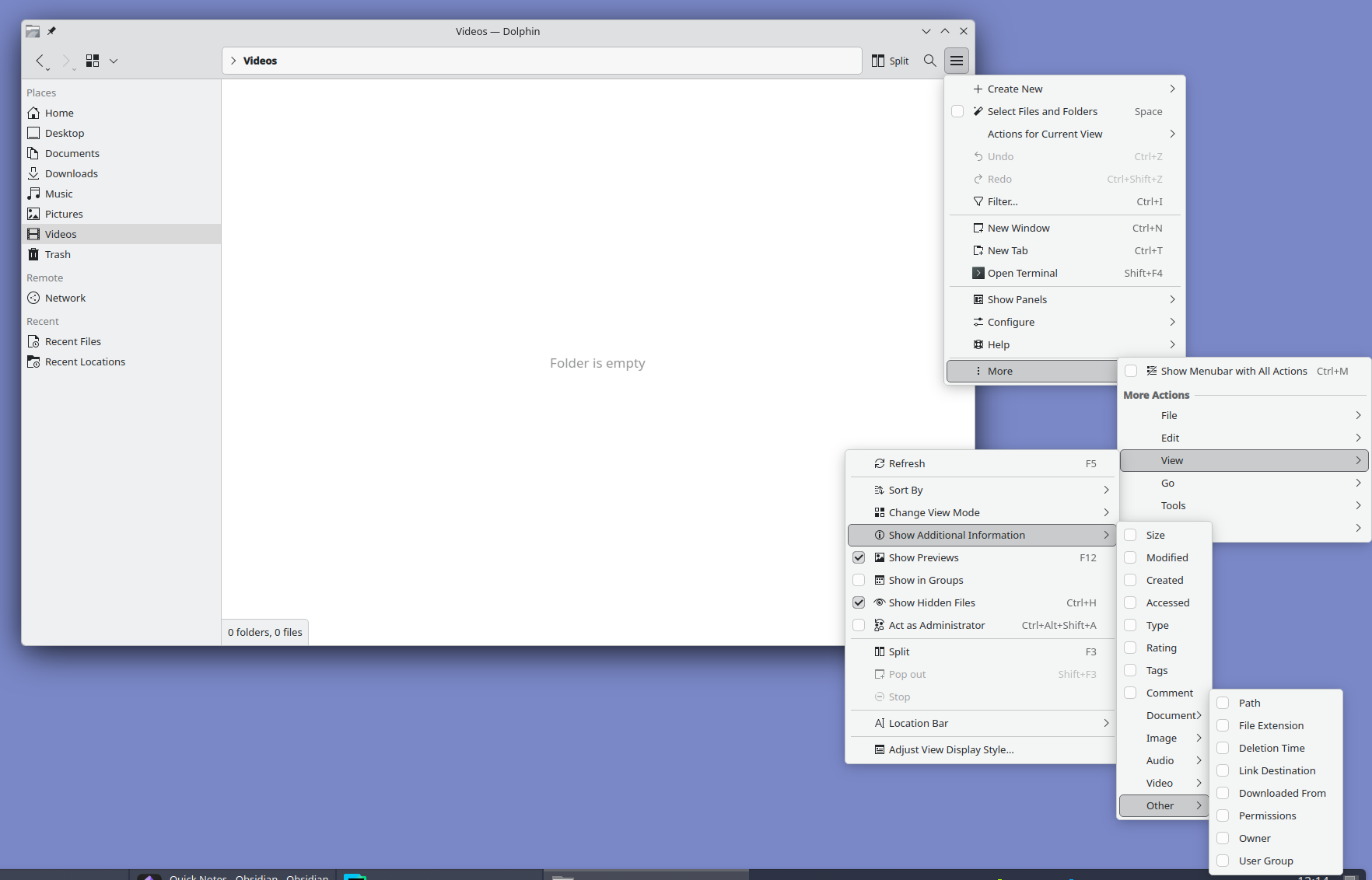
Look at it and tell me this is normal. I love Plasma but oh man do they need to hire a real designer. Someone with balls to unfuck the interface and move all advanced settings out of GUI into a well documented config file.
The sibling comment, meanwhile, is complaining about extra space devoted to explicit controls for all of the extra options. Well, you can't have it both ways. If you want to have a lot of features and options, you have to either devote some space in the main UI to them, or have a lot of deeply nested menus like that.
Or I guess you could do a config file somewhere, but IMO that's even worse. If we're going to complain about bad UIs, isn't it even worse than some deeply nested menus to need to open a separate file somewhere else with a separate program and learn whatever config file syntax they happen to use.
I'd rather have all that mess removed and settings 1% of the user base "needs" moved to a config file. I don't want to add an another layer of complexity with external configuration tools.
Konsole on left, ghostty (which is gtk) on right. The latter has at least 3 additional lines visible outputting the same command. The giant copy paste buttons, tab bar which wastes a ton of space, are typical of kde apps. The klutter isn’t just visually annoying it makes the apps less useful.
There's plenty of valid criticism of GTK but choosing C over C++ isn't one of them. It seems like there is a new Rust GTK app every week, and other languages as well, thanks to the availability of bindings.
I'm curious how long relying on C++ contributions is going to last.
And then kmail... kmail is bad.
No alignment issues, menus sorted by professional designers, easier to learn UX like ribbon menus and a lot more.
Feel like the design issues stem from it being shaped by existing power users. Familiarity tend to downplay design issues so stability took priority, even though the UX never should've been stabilised in the first place.
Plus AFAIK it's the most multi threaded so it's the hardest to freeze.