Hacker News new | past | comments | ask | show | jobs | submit

Things That Turbo Pascal Is Smaller Than (2011)

https://prog21.dadgum.com/116.html
Anders Heljsberg GOAT. Turbo Pascal, Delphi, C#, TypeScript, just a phenomenal career marked with better taste than any other language designer I can think of, certainly any designer whose work is so mainstream.
loading story #50509163
Given development speed is way up, I'd be interested to see what a from-basic-principles simple and efficient OS and programming system might look like. Or people trying radically different versions of efficiency and simplicity, like an OS that uses an existing battle-tested sandboxed execution environment like v8 for userspace safety/isolation.

Fundamentally, many inefficiencies were justified for developer productivity, and I'm not sure that makes sense anymore, and the cost of larger projects with clear abstraction boundaries has plummetted.

loading story #50507497
loading story #50509336
loading story #50507458
loading story #50507608
While some comparisons may look silly, the fact that the touch command's binary should exceed Turbo Pascal is insane: the command basically creates an empty file or updates the file change date if the file already exists, not more.

There's no reason (other than laziness) why that should take more than 2k.

On the other hand, a lot of boilerplace code is repeated in each and every command. When I first learned as a kid about UNIX commands being ordinary programs, I was intrigued (there is nothing "special" about them, you can also write your own!) but also shocked about the overhead compared to an architecture in which e.g. the shell contained all (at least core) commands compiled into a single binary, which could share all the error handing, startup code, command line parsing code and so on.

loading story #50508795
loading story #50508786
Why did Pascal basically die completely? It seems like a hugely influential language and was very loved, but there are plenty of other languages which still seem to have a lot of legacy code. Where is Pascal?
In a way it didn't, the Lazarus project is the current most well-known incarnation. But that itself tells a story: it's for desktop applications, mainly. It never really had a "here's how you do a web app" story around it. There was a period 1998-2002 when Delphi was hot (and it genuinely was very good) but all the cool kids saw PHP3 and Flash and hopped aboard, and at that point, in retrospect, you can see the start of the decline of desktop applications. By the time Rails landed in (I think?) 2008 "do everything on the web" was what a lot of people were already talking about, even if the truth of that didn't really land until much later.

Really it could have been go-lang before go-lang and I'm not sure why it wasn't other than that it wouldn't have been controllable by the folks at Google.

loading story #50509188
Lua, Go, and Nim have some Pascal roots, according to https://en.wikipedia.org/wiki/Generational_list_of_programmi...

Though Borland had some commercial success, I remember Pascal mainly as a teaching language.

loading story #50509508
loading story #50508501
loading story #50508320
Because it didn't have nul-terminated strings.
The main problem with Pascal was not having a standard at a time when having a standard was important for adoption. There were several successful implementations like Borland's, and the version used in the Macintosh, but being closed products they never talked to each other. It's similar to the situation of Basic: lots of code was created in Basic but none was compatible with a standard and was essentially lost.
loading story #50509210
Not just having a standard but being able to collectively evolve a standard.

In the absence of that, Pascal’s creators and commercializers invented follow-on languages, including the most successful thread via Hejlsberg as we’re discussing here: Object Pascal -> Delphi -> C#/.NET—with a brief detour to J++, which I don’t know enough about to understand if it belongs in this sequence.

loading story #50509279
Carmack developing DOOM on a NeXT and porting it to PC was a very good advertisement for C.
loading story #50509283
Free Pascal/Lazarus it's rocking nice tools such as Peazip and other stuff like Carte Du Ciel and some RAD tools in the enterprise. On the niche geeky world, there's T3X at https://t3x.org which is semi-Pascal like.
loading story #50509320
Kaaaaaaaaaaaahhhnnn!!!
I’m tired of those senseless comparisons

Bytes have history, meaning, context of creation, different utilities and different cost associated with creation/transfer/storage/manipulation

We could also use those comparisons to praise how complicated our current world has become and how good we are at managing such complexity

{"deleted":true,"id":50508565,"parent":50506894,"time":1794762503,"type":"comment"}
loading story #50510593
The wall of defensive, hostile replies to this simple post is expected. Today’s programmers need to feel like they are an elite class above the rabble and programming is their identity. When someone shows them an example of what talented programming really looks like, they have to pile on and dismiss it from a thousand cuts. The guy who wrote Pascal understood the system top to bottom, and understood computer science. There are maybe a few thousand programmers alive today with that kind of skill, and it hurts the egos of the average HN typescript scrum jockey to see something they just don’t comprehend so they lash out at it.
loading story #50510172
It's always an interesting thought that I had meetings about the log aggregation dropping stack traces that would take ~3 3.5" floppies to store. Each.

Zabbix also confuses operators at this point. I recently had to increase a cache. I chose to go from a solid 4MB to a luxurious 256MB.

I know high-performance Java, so just a little jab there, but you don't size JVM parameters like that, except maybe code caches. And before Rust comes in, we also have a Rust application running without good resource control and it wouldn't like those resource constraints.

There is truth to this article.

loading story #50509516

    > zlib.h in the Mac OS X Lion SDK (80,504 bytes).
What a stupid comparison. zlib.h is probably 99% comments.
loading story #50508856
This is only slightly related but I just made a Turbo Vision UI for Claude Code sessions.

https://github.com/runvnc/tvclaude

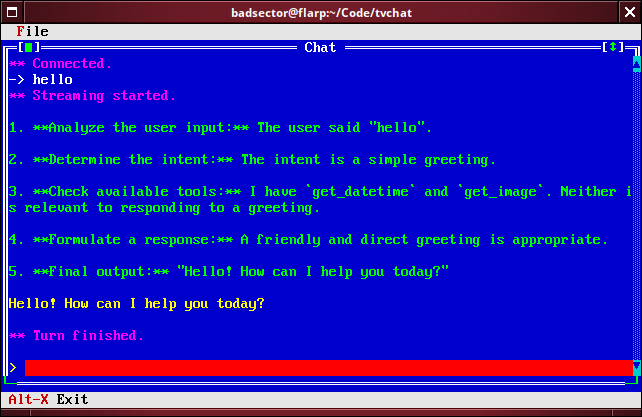
Amusingly i also used Turbo Vision to make some agentic harness[0] :-P (though mine is meant to talk with llama-server via its OpenAI compatible endpoint since i'm using local models - the one in the shot is Gemma 4 E4B which i'm using for testing).

That said i never finished that and ended up making another one (using tvchat as a base since it had largely working communication and session management) that acts as a server/daemon inside the container is meant to run in the background and provides a web-based UI instead.

http://runtimeterror.com/pages/iv/images/25b1d4b43bb3467e392...
cool. can you drag & drop in files (e.g. screenshots, PDFs, video recordings, text files, etc.) for context when you work on features or bug fixes? Cursor is great at workflows like that.
no, but good idea, I am having Claude add that.
Well, yeah. Back in the mid-80's, software needed to be usable on a computer with a single 360KB floppy drive. (No HD, no SSD, no USB, no network, no ...) And even a big budget for RAM - which cost many orders of magnitude more than today - would really not get you around Bill Gates' 640KB DOS memory limit.

Comparing to current-day stuff is kinda like comparing battery-powered bathtub toys to jetskis.

loading story #50507477
loading story #50507565
loading story #50507519
loading story #50507490
loading story #50507478
loading story #50510834
This article basically says that a text based application (turbo pascal) is smaller than images and PDFs. Obviously.
loading story #50507292
loading story #50507353