
The State of Context Engineering
https://www.dbreunig.com/2026/10/24/the-state-of-context-engineering.htmlThere is more to it than just reducing content in context. LLMs attention mechanism works by finding graphs of related words and concepts and it works best when the relevant relationships are close together in the text. Length matters but how well the information is organized matters as well.
It's useful to be familiar with the concept of dependency length. The two sentences in this image ( https://benoitessiambre.com/img/dependencylength.png ) have the same words and same meaning but sentence C is organised to minimize the distance between related words.
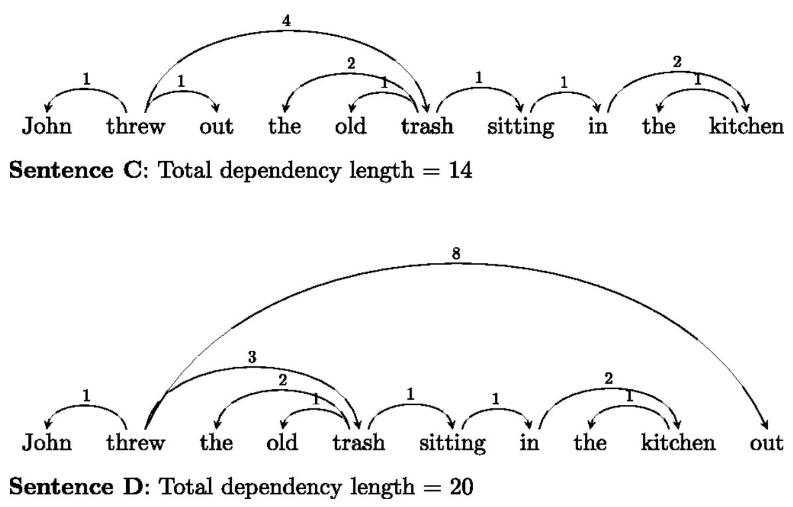
This can also apply to paragraphs and sections. Ordering them so that related information is recursively closer together, helps AIs think better (also helps humans, Dependency Length Minimization, DLM is an idea from psycho-linguistics).
This is one reason progressive disclosure and sub agents are important. Including unnecessary information spreads apart surrounding information and makes it more difficult for AIs to figure things out.
For eg. optimizing skills, it can help to put more important information at the bottom of a skill. Usually after a skill is loaded, the AI will start “thinking”, talking to itself to try to reason through a problem. The thinking block will have an easier time considering the text closest to it, the last part of the skill, than information farther up.
Thinking blocks can produce a lot of text (a lot of it often hidden from users) that also spreads information apart. Sometimes, when an early instruction is still relevant but there’s been a lot of thinking and discussion added to the context since, it’s worth repeating a summary the early information ( keeping in mind that too many reminders can also spread other information apart ). I think however, LLMs are tuned to overweight very early information so that they don't disregard system prompts. You might be able to exploit this by placing some important facts near the very beginning of a conversation.
If you've ever written compression algorithms where repeated blocks are referenced instead of encoded, you'll be familiar with how related information being clustered allows for better compression. It's another example of the parallels between intelligence and compression and it hints at the information theoretic aspect of DLM.
An implementation of this idea based on the pi harness: https://github.com/jonaslsaa/pi-optchat
[1]: https://gist.github.com/VictorTaelin/91837951a5ce5b38f341ec1...
> I think that’s the context problem of tomorrow.
This passage is explains why humans have imperfect memory. Seems the perfect memory we wish LLMs had impedes creativity and is maladaptive.
Strategic forgetting helps put the non-deterministic machine to best use. LLMs don't need perfect memory; that's covered by the computer itself.
I like that this justifies the continuing relevance of context engineering - a seemingly dated term - in the face of trends like loop engineering.
Mmm, to my mind, isn't this mixing completely different things? I thought poisoned context is stuff in the context that makes the model behave poorly. But if it's in the weights, that's just... model issues.
I really like this final sentence from the presentation. When I read this phrase, I realized that it captured one of the core dynamics that I've been using to figure out when and how to apply AI to a task. I often find myself trying to figure out if it is better to A) ask the AI to do a task for me or B) ask the AI to build something that can do the task for me. A major component of that answer comes down to how deterministic or probabilistic the task is.
I don't find this to be true, at least with the newer models. I also find that the models fill up to 250k very quickly (presumably mostly by looking through the codebase). Without that context I find the models perform badly. I also don't really notice that large of a change until around 700-800k context and even then it isn't as bad as it used to be. I suspect, that (especially for coding), the long horizon RLVR tasks have helped with this quite a bit.
Interestingly, the artifacts include not just code but alao retroactive design and retroactive “execution plan”. I feed them to another agent to validate the approach and resume work with fresh context and update mission statement.
Unexpectedly, design doc and an execution plan are now outcomes of coding process, not inputs to it. I’m not sure how to think about this.
From my understanding, if we have turns [A, B, C, D, E] and we decide that turn C is useless context, then we lose our cache for the [D, E] segment. (plz correct me if im wrong, I havent tested this)
Personally, I pay no mind to session state nowadays. I exclusively use provider native hosted compaction, which if you believe the providers, is the way to go. For context management- I spend most of my effort on the things which dump output back to the model.
If anyone has any good reads on benchmarking OpenAI and Anthropic hosted/native compaction against custom stuff, I would love to read!
That’s really true, but on the other hand, if there’s too little information, it also ends up working in strange ways. Most AGENT code anti-patterns work well at a medium amount of context, but when there’s too much or too little information, they don’t behave properly.