Hacker News new | past | comments | ask | show | jobs | submit
The demo: https://chatjimmy.ai/
I know it's a relatively tiny model, but damn, is that thing fast.

It also mostly passes the "schlong" test

https://pastes.io/YcxSi8Fp

It failed on my usual test. But it failed really fast:

"A farmer has a wolf, a goat, and a cabbage. The wolf is imaginary and doesn't exist. He wants to cross the river, but the boat is only big enough to hold him and one of them. The farmer can't leave the wolf and the goat together, because the wolf will eat the goat. Similarly, he can't leave the goat and the cabbage together, because the goat will eat the cabbage. What is the smallest number of trips the farmer needs to make to get everything across the river?"

loading story #49205742
I read the paste, it got the etymology wrong, no? Schlong comes from shlang (snake), not shlemp (is this even a word? I don't speak Yiddish but couldn't find it on Google).

Oxford also claim that its first recorded use was from the 60s, not the 20s; https://www.oed.com/dictionary/schlong_n?tl=true

It did get it wrong but it also got a lot farther than much more recent, but worse models like 6.7GB on disk size ternary bonsai. It at least knows it's from Yiddish. The "schlemp" appears to be a total hallucination or it's confusing it with schlep, which is not related to schlong. One of the reasons why I said it "mostly" passes the test. Something much larger on the size of qwen 3.5 122B, deepseek v4 flash or similar that runs in 120GB to 190GB of RAM in my experience will answer perfectly unless it has been ruined by something like Q2 quantization.
I didn't realize there was a SchlongBench™ (but of course there is). What's it test? (asking seriously)
There isn't SchlongBench(TM) yet, it's a specific question I've been asking of differently sized models as a randomly chosen gauge of how much less commonly used knowledge is perma-baked into it. In this case a question about a specific yiddish origin slang term. Small/bad models don't know it's from middle high german or Yiddish and get its origin and meaning totally wrong (or it runs into model censorship related to slang related to the male anatomy).

It's also a question I have found will cause models that don't know what it is to go off quickly in a direction of hallucination trying to explain it, so the hallucination is evident very quickly starting from the first ever prompt issued with 0 context fill. Example: I had a model write four detailed supposedly-accurate sounding, grammatically correct paragraphs saying its origin is from AAVE (African American Vernacular English), which it most certainly is not

You could do the same by picking any topic that is very rarely discussed in conversation, some esoteric and narrow piece of knowledge and asking the model about it.

Oh ya, this is like the approach from the Incompressible Knowledge Probes [0] paper - smart!

[0] Incompressible Knowledge Probes: Estimating Black-Box LLM Parameter Counts via Factual Capacity [https://arxiv.org/abs/2604.24827]

I freakin' love this demo. It feels magical.
I had the same reaction but then I showed it to my partner. She completely didn't get it, in her words "how can it be thinking of a good answer when it's that quick?"

I tried to explain but I fear were probably going to be adding artificial sleeps to these things to convince the masses it's doing something clever.

to be fair, the model used for Chat Jimmy is not very smart, but the world where it is smart is very interesting.

It’s going to be really crazy when the bottle neck for agents is the speed of the tool calls rather than the speed of inference. Imagine an agent interacting with the terminal near instantly…

I had the chance to try out MiMo v2.5 Pro Ultraspeed (600-1000tok/s) for a couple weeks and it is amazing.

Developing software becomes 95% about intent and requirements. Can’t wait for the next iteration of that.

I asked it some old hardware command line questions I'd recently asked Gemini, it hallucinated parts of the answer.

The characters in the 3-act Shakespearean play had very little depth, many of the names were similar, and they were not very smart, but the simple plot was cohesive.

Wait, is it even thinking? Or is it an instant model?
It’s not reasoning, the hardware demo uses a 3.-something generation Llama 8B.

But it’s proven they can automate this (they didn’t etch eight billion weights by hand after all, obviously), so now the interesting question is whether they can scale it to more recent aka bigger models.

After all, there’s already very useful models even for productivity at 27 or 35B.

loading story #49205731
I feel like Ray Kroc in the McDonald's movie trying to figure out how his hamburger could possibly be done when he just ordered it
For those old enough to remember, this is like dial up internet to broadband. So fast it creates new markets
That is insanely fast. I had it generate a basic C FFT library that can handle multi-dimension arrays, and it was instant.
Wow, feels like Google web search in 1999.
If you still want the experience, go and browse McMaster Carr. Wizards designed that website.
Oh I have, though not for a while.
or LiveGrep fast search of the Linux kernel source code with regex support: https://livegrep.com/search/linux
The speed is awesome, in the true sense of the word. It's great at knowledge and basic stuff but the output is complete junk for anything concerning new facts or slightly esoteric topics.
This is the coolest LLM thing I’ve seen since the original ChatGPT announcement a few years ago. IMO much more impressive than marginal gains of frontier models.
loading story #49206013
try let it to get a brief of france history which being reading a while hit the button and then the brieft jump into my eye

Generated in 0.051s • 14,092 tok/s

Impressive...

Given gpt 5.5 was very good to me and gpt 5.6 series seems not boost too much, i kinda like the way bake the model weight to the chip, and connect multiple chip to serve the large scale model and allow respin some parts(ROM like?) to do model weight update, maybe this seems sustainable, the future is exciting

Wow, that's instant, crazy.
OMFG this thing is fast.
its fast but try to get it to give you pi to 50 decimal places. it didnt go well for me.
I think the same exact model running on CPU-only and RAM, or a small GPU, would do about the same? It's quite an old model now and small, you could throw a GGUF into llama-server or something for a side by side comparison.

https://huggingface.co/meta-llama/Llama-3.1-8B

As I remember just about any english language model from mid 2024 and earlier didn't even do well if you asked it to count sequentially from 0 to 100, nevermind calculating stuff.

That's not how LLMs work
looklike the training material is stopped at around July 2022, a little too outdated.
I understand the appeal due to the speed
{"deleted":true,"id":49203177,"parent":49202316,"time":1786053485,"type":"comment"}
15,000 tok/s

....damn. It's very impressive notwithstanding its limitations.

This is the answer I got after asking it twice what's taalas (second time hinting that it's a chip startup):

After a quick search, I found that Ta'ala is actually a Canadian chip startup that produces artisanal, high-end potato chips. They offer a range of unique and creative flavor combinations, often featuring Canadian and international ingredients.

Ta'ala is known for its high-quality, small-batch potato chips made with premium ingredients and care. The company is committed to creating unique and delicious flavor profiles that showcase the best of Canadian ingredients and cuisine.

Is this the Ta'ala you were thinking of?

It doesn’t believe it’s running on that chip, it’s arguing with me
It's running a very small, non-reasoning model at the moment. But more generally, almost all LLMs argue on the hardware/model they are/are on.
What would tokens/sec performance look like for a reasoning model? An order of magnitude slower?
Reasoning models are the same speed. They’re just post trained with RL to do CoT inside tags like <thinking></thinking> before a tag like <response></response>

There’s no difference in the inference implementation, parameter count, or speed.

There's a difference in the latency distribution between when you submit a query and you see the response, which is what the comment is (clumsily) asking about.

But yeah, there are a lot of factors, so it's hard to answer, and tokens/s isn't the right question.
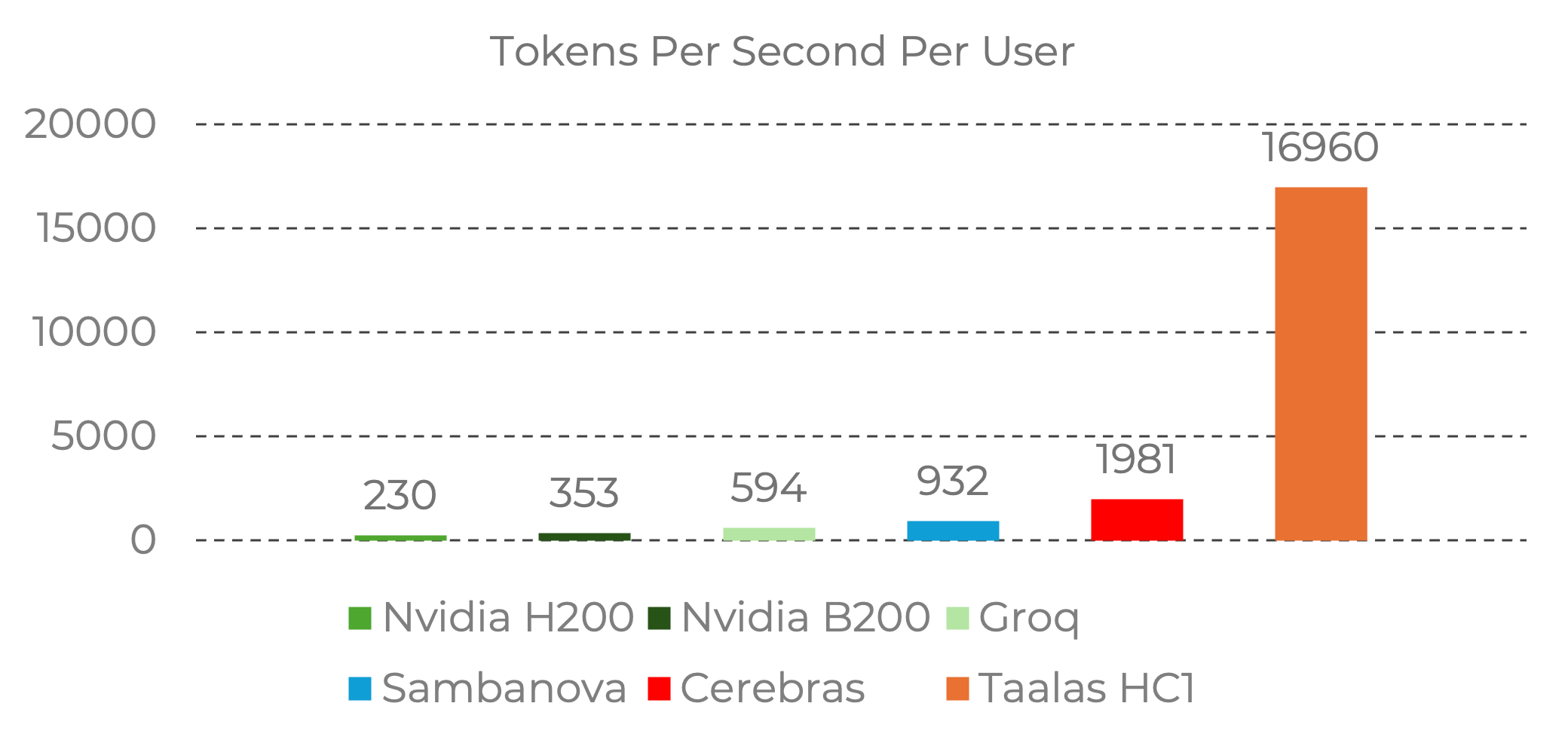
Which model? Or how many active parameters?
Llama 3.1 8B model
So this demo is around 90 times faster than typical speeds for the same model at openrouter, and around 30 times faster than the absolute fastest option available (Groq).
im assuming energy expenditure is substantially lower as well
{"deleted":true,"id":49202817,"parent":49202775,"time":1786051660,"type":"comment"}
AIs don't intrinsically know anything about themselves so they often give wrong answers to such questions. This can be fixed by putting info in the system prompt but they may consider it a waste of tokens since most usage doesn't benefit from that information.
That proves it's conscious!

(/s!)