
I see no indication that current human intelligence is at anything close to a historical pinnacle. Human knowledge, yes, but intelligence? No. Collectively, we're dumb and trending dumber, and the tendency towards lazy thoughtlessness which AI engenders will accelerate that trend.
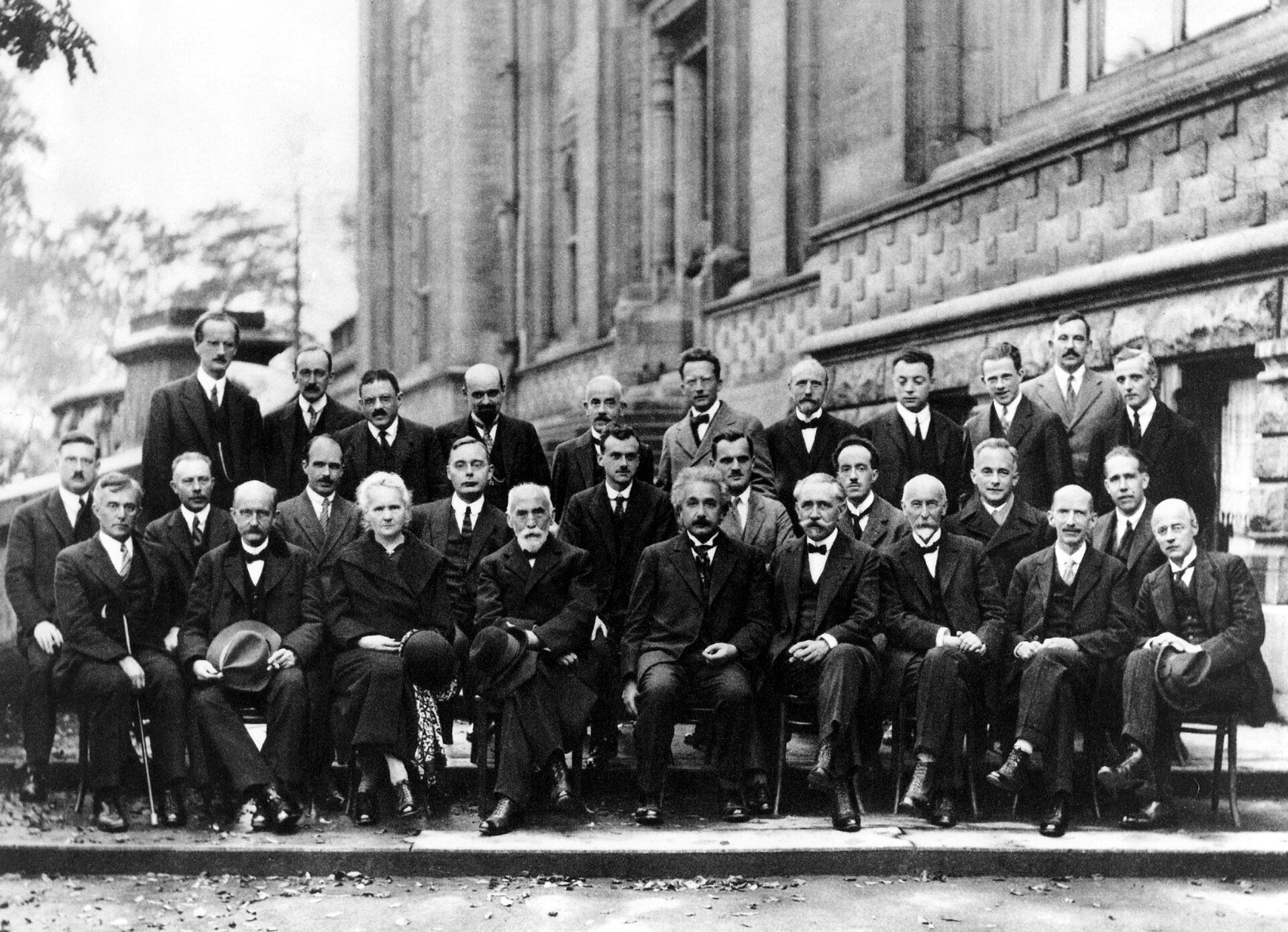
It really is a remarkable picture, but I'd like to note that it's all physicists, not scientists in general. It was the golden era of physics.

Also, science used to directly correlate with improvements in life standards. Nowadays we see advancements in science (AI, psychology) used to actively reduce the standard of life.
While all those are true they are not reflecting the level of intelligence of people: intelligent people take personal stupid decisions because while intelligence is a function of let's say the more "abstract brain", decisions are emotionally driven and influenced by the "ancient, threat focused, pleasure driven brain".
Here is a quick way to think about this: some intelligent people are obease, some others don't exercise, and others don't take their health seriously while also working on the most amazing problems we ever solved. You know what's the biggest paradox here: they all have the capacity to understand fully the impact of their lifestyle on their health but still making a life style change is hard due to not being driven by knowledge and logic.
Intelligence is the same but for mental faculties. A human is intelligent when they develop their critical thinking, memory, focus, logical reasoning, etc. A human is unintelligent when they fail to develop these things to their personal potential. And when I look around me I see a culture of inustrial-strength distraction that has robbed people of their ability to focus, I see encyclopedias in everyone's pockets that have robbed them of any incentive to remember, I see a society of comfortable complacency that has shielded them from any consequence of poor logical reasoning, and with LLMs I see a mass surrender of the need to exercise critical thinking in exchange for the warm embrace of thoughtlessness.
There's no reason that things need to be this way. The human hardware hasn't fundamentally changed in 100,000 years, and we have so many more resources today that it's easy to imagine that we could all be, collectively, more intelligent than ever if we could somehow inspire people to care. Sadly, we don't seem to be able to.
Like renewables were on track to bring us peak oil, maybe AI will bring us peak human intelligence.
But that shouldn't be any surprise. We're already at more than a hundred years of deliberate dumbing down of the population through schooling and mass media. These effects are exponential through generations.
We are at a peak in absolute terms, though the decline is coming quickly:
https://x.com/jonatanpallesen/status/2034755779501105321
But in relative terms intelligence has indeed been declining for a long time:
> I see no indication that current human intelligence is at anything close to a historical pinnacle. Human knowledge, yes, but intelligence? No. Collectively, we're dumb and trending dumber
Also, I think we (non-scientists) might be overestimating the average historical intelligence - see Flynn Effect [1] - perhaps because of a bias in our perception of the past levels based on who published books and thoughts - basically more intelligent members of our species.
> and the tendency towards lazy thoughtlessness which AI engenders
----------------
[1] https://en.wikipedia.org/wiki/Flynn_effect
[2] Thucydides, History of the Peloponnesian War, 1.20 — 5th c. BCE Greece. “So little pains do the vulgar take in the investigation of truth, accepting readily the first story that comes to hand.”
[3] Aristotle, Rhetoric, 1.2 — 4th c. BCE Greece. https://kairos.technorhetoric.net/stasis/2017/honeycutt/aris.... Aristotle treats public persuasion as necessary partly because ordinary audiences cannot easily follow complex chains of reasoning. He says rhetoric addresses deliberative matters before people “who cannot take in at a glance a complicated argument, or follow a long chain of reasoning.”
[4] Plato, Republic, Book V — 4th c. BCE Greece. https://topostext.org/work/768. Plato distinguishes philosophers from the many “lovers of sights and sounds,” who enjoy appearances but do not apprehend deeper truth. The text says their thought is “incapable” of grasping the underlying form or nature of beauty, and that few attain that deeper vision.
[5] Confucius, Analects, Book 2 — 5th c. BCE China. https://www.chinastory.cn/ywdbk/english/v1/detail/20190722/1.... "Learning without thought is pointless, Thought without learning is dangerous".
[6] Buddhist tradition, Dhammapada, Appamāda-vagga. https://suttacentral.net/dhp21-32/en/sujato. Dhammapada contrasts heedfulness with heedlessness, treating heedlessness as a central human failing. In one translation: “Heedfulness is the state free of death; heedlessness is the state of death. The heedful do not die, while the heedless are like the dead.”
[7] Francis Bacon, Novum Organum, “Idols of the Mind” — 1620. https://history.hanover.edu/texts/bacon/novorg.html. Bacon argues that the “Idols of the Tribe” are rooted in human nature itself, and that human understanding distorts reality like a false mirror.