
Full Spectrum and Infrared Photography
https://timstr.website/blog/fullspectrumphotography.htmlThe extent of this effect is very lens dependent. It also occurs in different colours of visible light too, depending on how well the lens design accounts for it. Optically, the term is "Chromatic Aberration" - lens designers try and account for it in the visible spectrum with optical design and lens coatings, and modern designs are generally extremely well corrected in the visible spectrum. _Usually_ designers aren't worried about the design correctly handing convergence into IR and UV, so how well designs focus them to the same point as the visible spectrum is hit or miss. There's specialist lenses out there that are designed specifically for wide spectrum apochromatism, but they tend to be special purpose and very expensive - especially if they handle UV.
The author mentions it at the bottom of the post as something they're interested in trying out, but I've found it very fun to play with dual bandpass filters - they pass a part of the Visible Spectrum + IR, which creates some interesting options in editing for visual display. There's an example in this set I shot with different filters - https://www.reddit.com/r/infraredphotography/comments/1dnki0...
On old school manual focus capable lenses you'll note a small (often red when colors were used to indicate f stops) dot to the left of the focus indication line.
https://commons.wikimedia.org/wiki/File:AiS_Nikkor_85mm-2.0_...
.jpg)
On more modern lenses, is simply a dot. https://www.mir.com.my/rb/photography/companies/nikon/nikkor...
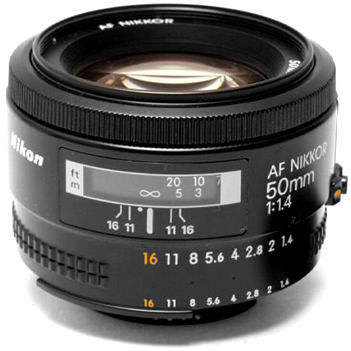
This was the offset for IR photography. You'd focus normally, and then make note of the focus distance and then line up the focus distance with the red dot for IR offset.
---
The UV photography often was done with other glass since the glass used by most lenses does an ok job of filtering UV light.
The 105mm UV lens for example - https://www.mir.com.my/rb/photography//hardwares/speciallens...
It's an oddball enough lens that others don't often make that it keeps getting special runs.
https://www.nikon.com/business/industrial-lenses/lineup/uv/
Costal Optics did a run of of the lens too - https://diglloyd.com/prem/s/DAP/Coastal60f4/Coastal60f4.html...
---
One of the photographers I've stumbled across from days of old who did UV nature photography (what do bees see?) http://www.naturfotograf.com/uvstart.html
I'm thinking of the beautiful cloud detail in the one IR shot where the visible light photo had lost all of that. Seems like some compositing (sort of like HDR) you could try to pull in the best of both worlds.
Side note: have always loved this image https://imgur.com/NZjWfWT of rainbows with UV and IR visible.
However, the amount of light from the sun drops off exponentially away from the peak at green-blue (yellow-green, after atmospheric filtering). You'd also have to really fake the dynamic range a lot to get it to look any different from IR+Vis+NUV. (If there was 0.001% as much x-ray light as there is, say, red light, DNA could only exist in the lightless depths of the ocean.)
So, it would look like an IR+Vis photo (light falls off pretty fast in the UV, too), except the ones you've seen oversell the IR.
So it would look like a Vis-light photo, with slightly shinier objects in it.
Sorry.
I've seen some examples in document forensics where a page that looks blank (or at least the ink is unrecognizably smudged) because of water exposure is completely legible with an infrared photo illuminated by UV.
I suspect there must be a hidden world only visible in IR and UV (and long-wave IR, e.g. "thermal").
With that setup, each pixel on the line sensor would effectively record the full spectral content of the light at that scanned position, all in a single acquisition.
You would reduce the time required by the root of the number of pixels you want (assuming a square image).
(This is what we do in momentum-resolved electron energy loss spectroscopy. In that situation we have electromagnetic lenses that focus the electrons that have been dispersed, so we don't have as bad a chromatic aberration problem as the other response mentions).
I would love to see e.g. a butterfly image with a slider that I could drag to choose the wavelength shown!!
Given that regular phone cameras have sensors that detect RGB, I wonder if one could notice improved image sharpness if one had three camera lenses (and used single-color sensors) next to one another laterally, with a color filter for R, G and B for each one respectively. So that the camera could focus perfectly for each wavelength.
The Coastal Optical 60mm is a frequently cited one. UV in particular is challenging, because glass that works well in the visible light range can be quite poorly translucent in UV. Quartz is better, but drives up the cost a lot, and comes with other tradeoffs.
Shoot a checkerboard at both wavelengths each focused properly and then compute the mapping.
If you're shooting macro stuff then maybe you are changing the effective location of the camera slightly depending on the exact mechanics of the lens and whether the aperture slides with the focusing, but the couple of mm shift in camera location won't matter for landscapes.
Alternatively, use cine lenses which are engineered not to breathe, but they are typically more expensive for that reason.
https://petapixel.com/2019/07/13/shooting-high-res-thermal-p...